That little bit of exercise

Read the post here.
Brian Mossop is currently the Community Editor at Wired, where he works across the brand, both magazine and website, to build and maintain strong social communities. Brian received a BS in Electrical Engineering from Lafayette College, and a PhD in Biomedical Engineering from Duke University in 2006. His postdoctoral work was in neuroscience at UCSF and Genentech.
Brian has written about science for Wired, Scientific American, Slate, Scientific American MIND, and elsewhere. He primarily cover topics on neuroscience, development, behavior change, and health.
Contact Brian at brian.mossop@gmail.com, on Twitter (@bmossop), or visit his personal website.
Using Blood Pressure Cuffs to Enhance Sports Performance
Over at Wired Playbook, I have a new article highlighting a sports performance-enhancing technique where blood flow is temporarily reduced to a limb, in order to prime the muscle for future stress during exercise:

Over at Wired Playbook, I have a new article highlighting a sports performance-enhancing technique where blood flow is temporarily reduced to a limb, in order to prime the muscle for future stress during exercise:
The study builds off research first conducted in the 1980s by cardiovascular pioneer Keith Reimer that examined infarcts, areas of dead cardiac tissue that resulted after heart attacks, when blood flow (and, hence, oxygen) were cut off for extended periods of time. Reimer and his colleagues discovered that much less heart muscle deteriorated when the tissue had previously experienced a few training sessions where blood flow was slightly reduced.
It was as if practice makes perfect, and the previous bouts of low blood flow, which researchers refer to as ischemic preconditioning, primed the heart muscle to endure more serious, even catastrophic, events. When a life-threatening heart attack transpired, instead of shriveling away, the preconditioned heart muscle seemed to stand strong.
Read the full story here.
Photo via Flickr / jasleen_kaur

Jean-St-Michel E, Manlhiot C, Li J, Tropak M, Michelsen MM, Schmidt MR, McCrindle BW, Wells GD, & Redington AN (2010). Remote Preconditioning Improves Maximal Performance in Highly-Trained Athletes. Medicine and science in sports and exercise PMID: 21131871
Wave of Rhabdomyolysis in Oregon High School Football Players
Rhabdomyolysis is caused by severe injury to muscle cells. The condition is serious, and can lead to kidney failure if not properly treated. Basically, muscle cells break down and release byproducts in the bloodstream. One particular protein, myoglobin, is especially hard on the kidneys. Rhabdomyolysis usually occurs when your average couch-potato decides to head to the gym for the first time in months, pushes his-or herself to the brink of exhaustion, and doesn't drink enough water. So today's NYT story that said twenty-four athletes from McMinnville High School in Oregon were diagnosed at their local hospital with rhabdomyolysis caught my attention. The players began complaining about symptoms -- which typically include sore/swollen muscles and dark urine -- a few days after an intense preseason workout.
Rhabdomyolysis is caused by severe injury to muscle cells. The condition is serious, and can lead to kidney failure if not properly treated. Basically, muscle cells break down and release byproducts in the bloodstream. One particular protein, myoglobin, is especially hard on the kidneys. Rhabdomyolysis usually occurs when your average couch-potato decides to head to the gym for the first time in months, pushes his-or herself to the brink of exhaustion, and doesn't drink enough water. So today's NYT story that said twenty-four athletes from McMinnville High School in Oregon were diagnosed at their local hospital with rhabdomyolysis caught my attention. The players began complaining about symptoms -- which typically include sore/swollen muscles and dark urine -- a few days after an intense preseason workout.
Was the summer layoff to blame? Did the players report to camp out of shape, force their way through an intense workout, and not stay properly hydrated? Maybe. But doctors aren't ruling out the possibility that supplements may have been involved. Some of the student-athletes reported they regularly consumed a protein shake, but weren't sure exactly what was in it.
Creatine is a popular supplement among high school and college power athletes. The supplement works by increasing water retention in the body, which makes the muscle fibers larger. But if the water pressure inside the cells is high enough, it's possible the increased stress could potentially break down the cells themselves. In fact, there have been a few case studies showing that taking creatine supplements, especially in high doses, may trigger rhabdomyolysis.
Granted, there are a number of compounding factors at play. And we don't even know if creatine was in the protein shake or not. But it certainly makes you wonder when you see a wave of rhabdomyolysis occur in otherwise healthy young athletes.
So I'll keep my eyes peeled for the results of the lab reports, which should surface in the coming days.
photo via Flickr @rdesai
Sex, Stress, and Neurogenesis
There’s an article in the latest issue of Wired by Jonah Lehrer explaining just how dangerous stress can be to our health. It’s a fascinating read -- and instead of relying on my poor attempt to paraphrase -- I suggest checking out the article in its entirety.
There’s an article in the latest issue of Wired by Jonah Lehrer explaining just how dangerous stress can be to our health. It’s a fascinating read -- and instead of relying on my poor attempt to paraphrase -- I suggest checking out the article in its entirety.
The part of the story that struck a particular chord with me was Lehrer’s explanation of the experiments done by Elizabeth Gould, who studies how stress hormones affect the growth of new brain cells in adult brain, a process called neurogenesis. Gould’s previous work, as noted by Lehrer, showed that when animals get stressed out, levels of glucocorticoids -- one type of stress hormone -- skyrocket in their brains. With brain cells wading in a constant bath of these stress hormones, neurogenesis comes to a screeching halt.
The take-home message from Lehrer’s article: glucocorticoids are bad. And indeed, they do make bad things happen in the brain. Aside from the fact that stressed-out animals have less neurogenesis, if you take an animal and inject glucocorticoids directly, new brain cells also stop forming. Lehrer’s suggests that if we find ways to prevent or otherwise interfere with stress hormones (through a vaccine or otherwise), we could mitigate the effect stress has on our emotional well-being and, ultimately, its complex interaction with disease.
I’ve been putting off (for several weeks now) writing a post on the most recent experiment to come out of Gould’s lab, published in mid-July in PLoS One. Lehrer’s story finally lit the fire under me.
The term “stress” has a very deliberate negative connotation. We need this term to bucket somewhat-hard-to-explain feelings, like experiencing “pressure” at work. But the term is far more encompassing than that. Stress, by definition, is a measure of how the body responds to a challenge. Sometimes the challenge can be a threat -- a deadline at work or a difficult family situation -- and triggers the all-too-familiar anxiety we’ve come to expect. This is the bad type of stress Lehrer discussed. But the challenge can also be a something, well, good, that temporarily takes our body out of balance. Consider what happens when you exercise. Going out for a run will create a physiological burden as the heart beats faster and faster, trying to match blood flow to the demands of the muscles and lungs. This physical exertion is also a type of stress, a good kind of stress, if you will.
The effects of the two types of stress on the brain are completely different: While the bad stress decreases neurogenesis, the good type of stress, on the other hand, actively stimulates extra brain cell growth. Although the brain responds in different ways, both good and bad stress increase the levels of glucocorticoids in the body. Knowing glucocorticoids are dangerous to the brain, researchers still scratch their heads over how exercise could battle these stress hormones, and win.
But Elizabeth Gould has a new theory.
Exercise makes us feel good about ourselves. We like the sense of accomplishment. We celebrate the weight we’ve lost and our increased fitness. Gould believes that this hedonistic value of exercise could somehow trump the nasty effects seen when glucocorticoid levels rise. But exercise is such a complex action. Sure, there’s a hedonistic component, but there’s also a hefty physiologic one.
To give her theory some teeth, Gould would have to prove that another stressor with hedonistic value also boosts neurogenesis. So this time around, instead of exercise, Gould’s lab used a simpler, less physically-demanding, but equally powerful positive stressor: sex.
While not typically considered a stress by popular definition, sex fits the bill, as it’s been shown to increase glucocorticoid levels in the brain.
Gould’s results show that a single sexual encounter is enough to raise glucocorticoids and increase neurogenesis in the hippocampus of male mice. After repeated sexual experiences, the glucocorticoid levels stabilize, but the brain continues to grow new neurons and the number of synapses increases.
While this study doesn’t answer all of the questions surrounding glucocorticoids, stress, and the brain, it shows the story is far more complicated than initially thought. Chronic good stress continually increases neurogenesis, but it also seems to level off the stress hormones themselves. Gould’s results support the notion that the hedonistic aspect of good stress may in fact be the active ingredient that keeps the dangerous effects of glucocorticoids at bay.
Leuner, B., Glasper, E., & Gould, E. (2010). Sexual Experience Promotes Adult Neurogenesis in the Hippocampus Despite an Initial Elevation in Stress Hormones PLoS ONE, 5 (7) DOI: 10.1371/journal.pone.0011597
Exercise and Anger
Exercising people are happy people.
Nonsense. Ever see someone’s face at mile 20 of a marathon? Do they look happy to you?
OK, maybe people aren’t happy while exercising, but evidence shows they’re better off, in general, after the fact. Physical activity has a positive effect on mood, and is considered a valid treatment strategy to battle anxiety disorders and even depression. Although most explanations are somewhat wishy-washy, researchers believe that hedonistic value of exercise is important in mental health. Exercise simply makes us feel good about ourselves. And this is not only true in humans, but in animals, as well. Rats and mice that are given free access to a running wheel will use it, and lab rodents typically won’t do anything that doesn’t provide them some sort of pleasure.

Exercising people are happy people.
Nonsense. Ever see someone’s face at mile 20 of a marathon? Do they look happy to you?
OK, maybe people aren’t happy while exercising, but evidence shows they’re better off, in general, after the fact. Physical activity has a positive effect on mood, and is considered a valid treatment strategy to battle anxiety disorders and even depression. Although most explanations are somewhat wishy-washy, researchers believe that hedonistic value of exercise is important in mental health. Exercise simply makes us feel good about ourselves. And this is not only true in humans, but in animals, as well. Rats and mice that are given free access to a running wheel will use it, and lab rodents typically won’t do anything that doesn’t provide them some sort of pleasure.
But what about anger -- can exercise prevent us from getting angry in the first place?
Gretchen Reynolds’ new post on the ‘NYT Well’ column discuss new evidence that shows exercise -- even a single, isolated session -- can alter how we respond to challenges that angered us in the past.
In one particular study, researchers showed a group of undergraduate students a series of images while recording EEG signals from their brains. Some of the images were pleasant, while others were meant to make the participants angry. After the students watched the videos, they rated their current anger on a scale from 0 to 9. At baseline, the electrical activity in the brains of students showed they were disturbed by the nastier images, and they all rated their anger on the high-side of the 0-9 scale.
The students were then divided into two groups. And on the days between the experiment, one group did some light/moderate exercise (like 30 minutes on a stationary bike), while the other group did not exercise at all. When re-tested, the electrical activity of the brains of all the students, regardless if they exercised or not, showed that they became angry while watching the videos. But the students that had exercised the day before were able to shake-off their anger, and at the end of the session, they just weren’t as upset as those in the physically-inactive group.
The results suggest that exercise may in fact be a preventive measure against the buildup of anger.
The rest of Reynolds’ post talks about the mechanism of how exercise could make us less like to boil over in anger. She provides some hand-waiving explanations, saying changes in serotonin levels in chronic exercisers make them less angry. While this may be true, exercise is a complex activity that changes so much in the body -- neurotransmitter levels, blood flow, hormone levels, just to name a few -- so I’d caution readers that it’s hard to pinpoint which physiological catalyst could be real the anger-fighting superhero. Or maybe it’s not one particular molecule, but the sum total that makes exercise so powerful.
Time to Make a Dopamine Run
It's 6am and my alarm clock is buzzing, but I don't hear it. I don't even move. But the incessant noise wakes my wife, and her gentle nudges (read: elbows) and soft whispers (read: expletives) eventually convince me to get out of bed. It seemed like a great idea: Run in the morning before work, to free up countless evening hours. “Think of all you'll get done at night if you don't have to run after work”, I said to myself. “For once you'll actually hit your goal of blogging multiple posts per week! Maybe even finish some of those half-read books lining the shelves.” But two days into the new regime, I'm having second thoughts.
It's 6am and my alarm clock is buzzing, but I don't hear it. I don't even move. But the incessant noise wakes my wife, and her gentle nudges (read: elbows) and soft whispers (read: expletives) eventually convince me to get out of bed. It seemed like a great idea: Run in the morning before work, to free up countless evening hours. “Think of all you'll get done at night if you don't have to run after work”, I said to myself. “For once you'll actually hit your goal of blogging multiple posts per week! Maybe even finish some of those half-read books lining the shelves.” But two days into the new regime, I'm having second thoughts.
It's freaking early. I mean, I've gotten up at the crack of dawn to work on blog posts, but going out for a 6-mile run requires a bit more activation energy than typing away on the computer.
To make matters worse, I just don't feel like running today. It's cold and raining. I can hear the wind blowing from inside my apartment. My warm bed is calling to me, but I muster the will to put on my running clothes, and step outside.
I trod along, slower than usual, because my legs are still tight. A few minutes into the workout, a homeless man approaches me on a rickety bike. He rides close by, taunting me. “You keep running, boy”, he says. “Gonna run yourself right into the grave!” Living in San Francisco, I’ve grown moderately accustomed to such neighborhood friends. But today, instead of being a minor annoyance I shrug off, this guy truly sounds like the voice of reason.
We talk a lot on this blog about ways to drive healthy behavior change: Self-tracking and the Hawthorne effect. Competition and group dynamics. But no way around it, rewards are the heart of behavior change, thanks to the way our brains respond to the molecule dopamine, which differentiates what you have to do, from what you want to do. Dopamine turns a chore into a hobby.
The clearest example of the dopamine reward system in action is the now-famous experiments of Ivan Pavlov. In the early 1900’s, Pavlov noticed that when dogs saw food coming, they began to salivate. The dog's brains were moving faster than their bodies, already anticipating the sweet reward of food before a morsel even hit their mouths. So Pavlov wondered what would happen when he paired a food reward with a random stimulus, such as a bell, whistle, or electric shock. We all know how the story ends: After training, Pavlov's dogs salivated when they heard they bell, regardless if they got a food reward or not.
Pavlov's experiment unlocked our understanding of classical conditioning: Pair a random stimulus close enough to a reward, and soon the stimulus itself tells the brain to get ready for the big payout.
With brains wired for immediate reward in a world of instant gratification, it’s easy to see why we struggle when starting a new exercise routine. The stimulus (the act of running) is so far separated from the reward (the endorphin kick, the runner’s high, or even improvements in our health and fitness).
So how can we ever be expected to change a behavior unless we get an instant payout for our actions? A hand-waiving explanation would be we’ve simply trained our brains to wait longer and longer for the reward. On the other hand, consider this: If you talk to enough runners, they'll tell you they don't “feel right” when they haven’t gone for a run in a few days. They feel “off” if they don’t get their fix. I’m certainly not the first to wonder if chronic exercise somehow primes the dopamine reward system to make us crave the activity, the old “exercise addiction” theory. But the similarities between the two are striking. Could we one day use what we know about addiction to drugs to reveal new ways to get people hooked on positive behavior changes? I’m still funneling through the scientific literature regarding exercise addiction, so I’ll give you updates as the ideas surface.
For any new runners out there looking for pearls of wisdom about what to do when the going gets tough, I leave you with this: I know that even experienced runners lack motivation at times. In fact, I don't know that it ever gets easier to plunge into the first few steps of a run on days you’re dealing with bad weather, a busy schedule, or belligerent guys on bikes. But hang in there, your body and brain will thank you (hopefullly sooner than) later.
What Did the NIH Report on Lifestyle Modification/Alzheimer's Really Say?
My inbox flooded with links to the report released by NIH (and evangelized by TIME) stating that lifestyle interventions (diet, physical activity, mental exercises, etc.) may not be that effective in preventing Alzheimer's Disease. Before I mount my full counterattack, I need to carefully read through the studies the meta-analysis cites. Still, a quick glance at the exclusion criteria of the meta-analysis reveals the authors limited their review to studies using patients over the age of fifty. So really, these results imply that lifestyle modifications may not prevent, delay, or treat Alzheimer's Disease if you start these changes later in life.
My inbox flooded with links to the report released by NIH (and evangelized by TIME) stating that lifestyle interventions (diet, physical activity, mental exercises, etc.) may not be that effective in preventing Alzheimer's Disease. Before I mount my full counterattack, I need to carefully read through the studies the meta-analysis cites. Still, a quick glance at the exclusion criteria of the meta-analysis reveals the authors limited their review to studies using patients over the age of fifty. So really, these results imply that lifestyle modifications may not prevent, delay, or treat Alzheimer's Disease if you start these changes later in life.
My second point is that all lifestyle modifications are not created equal. Scientific evidence in animal studies suggests that of all interventions, aerobic exercise is our best chance of staving off cognitive decline. In fact, this meta-analysis also found some correlation between exercise and preserving or improving cognitive ability.
There's a good article in The Economist that discusses the failures of the drug industry to find a solution to treating Alzheimer's Disease. One particular quote resonates with my feelings on the NIH report:
Another fundamental problem is that, whatever is causing the damage, treatment is starting too late. By the time someone presents behavioural symptoms, such as forgetfulness, his brain is already in a significant state of disrepair. Even a “cure” is unlikely to restore lost function.
The Truth About Cholesterol
We've all heard the mantra: keep LDL levels – the “bad” cholesterol – down, and the “good” HDL cholesterol up. But thanks in part to the ubiquity of statins, such as Lipitor, which allow us to simply pop a pill to limit LDL production in the body, we've recently adopted tunnel vision when thinking about managing cholesterol. LDL levels are all we seem to care about now, as we strive for lower and lower numbers at each visit to the doctor's office. However, I think we're missing the bigger picture by focusing solely on LDL. First, it's made us reliant on medication to solve a problem that can many times be addressed with changes in diet and exercise regimes. Once someone starts Lipitor treatment, they'll be taking it for life, and if LDL levels don't quite get as low as they should, it's all too easy to solve the problem by increasing the dose. When patients first begin Lipitor treatment, physicians typically prescribe the lowest possible amount, 10mg. However, dosing can go as high as 80mg, which begs the question: Do higher doses of the drug really improve outcomes?
We've all heard the mantra: keep LDL levels – the “bad” cholesterol – down, and the “good” HDL cholesterol up. But thanks in part to the ubiquity of statins, such as Lipitor, which allow us to simply pop a pill to limit LDL production in the body, we've recently adopted tunnel vision when thinking about managing cholesterol. LDL levels are all we seem to care about now, as we strive for lower and lower numbers at each visit to the doctor's office. However, I think we're missing the bigger picture by focusing solely on LDL. First, it's made us reliant on medication to solve a problem that can many times be addressed with changes in diet and exercise regimes. Once someone starts Lipitor treatment, they'll be taking it for life, and if LDL levels don't quite get as low as they should, it's all too easy to solve the problem by increasing the dose. When patients first begin Lipitor treatment, physicians typically prescribe the lowest possible amount, 10mg. However, dosing can go as high as 80mg, which begs the question: Do higher doses of the drug really improve outcomes?
Second, the LDL value doesn't tell the whole story. After all, some people that have low LDL levels, still develop heart disease. When your doctor orders a standard lipid panel, LDLs are measured along with other lipids, such as high-density lipoprotein (HDL) cholesterol and triglycerides. What role do these other types of lipids play in cardiovascular health?
Let's start with the first question: Do higher doses of the drug really improve outcomes? This idea popped into my mind while reading a recent study in PLoS One that looked at LDL levels in patients diagnosed with familial hypercholesterolemia, a genetic predisposition to high levels of “bad” cholesterol. Caused by specific DNA mutations on a small region of chromosome 19, familial hypercholesterolemia drastically increases the chances that a person will develop heart disease. In fact, studies estimate that 85% of men with this mutation will have a heart attack by the age of 60.
The PLoS study found that only a minority of people with hypercholesterolemia brought their LDL levels down to recommended values, even when using statins. According to the authors, doctors were being too cautious with Lipitor dosing, and felt that higher doses would help patients reach their LDL targets.
Blood....beginning....to....boil.....
I know this isn't the first time I've climbed up on my soapbox saying “more medication is not always the answer”, but I wanted to find proof. Lo and behold, I came across a good study from the New England Journal of Medicine that calculated the risk of a major cardiovascular event depending on whether people were taking low- or high-doses of Lipitor (10 or 80 mg, respectively).
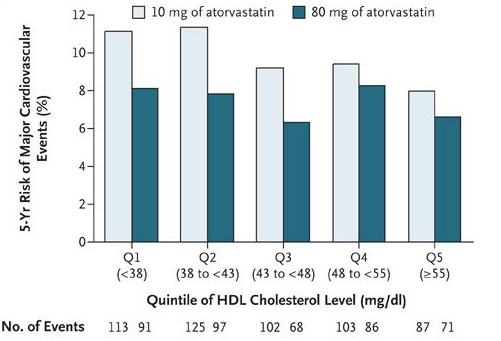
Take a look at Figure 1: Higher doses of Lipitor only made a big difference in risk when HDL levels were low. As HDL levels rose, the difference in height between the light- and dark-green bars went down. This means that if a person can get his or her “good” cholesterol high enough, higher doses of Lipitor will NOT necessarily decrease the risk of having a cardiovascular event.
This finding ties in well with the second question: What role do these other numbers play in cardiovascular health? From the NEJM study, we've seen that high HDL levels – which are a good thing – trump higher doses of Lipitor in preventing heart disease. But can adequate levels of “good” cholesterol also counterbalance the cardiovascular risk when “bad”cholesterol levels are high?
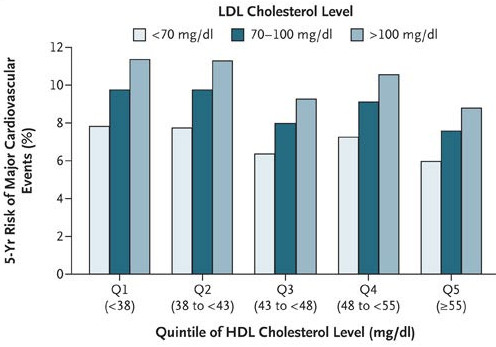
In a word, yes. Take a look at Figure 2: as HDL level increased, the risk of a cardiovascular
event decreased. But more surprising, if HDL and LDL levels were both high (above 55 and 100 mg/dL, respectively), a person had nearly equal risk of a major cardiovascular event as someone who had good LDLs (<70 mg/dL) but bad HDLs (<38 mg/dL)!
Similar evidence is mounting that high triglyceride levels are also an independent risk factor for heart disease. In fact, one study showed that even when people with a history of heart problems used statins to lower their LDLs to acceptable levels, slight increases in triglyceride levels significantly increased the chance they'd have another cardiovascular event.
So there is evidence that the other lipids in the blood (HDL and triglycerides) are equally important in predicting heart health. So is it possible to raise your HDL, or lower your triglyceride, levels? You bet. Studies have shown that simple, endurance exercise training significantly decreases triglyceride levels and raises HDL levels in many people.
I'm not saying that diet and exercise changes will work for everyone. But statins shouldn't be viewed as the magic bullet, either. As more studies on the science of exercise emerge, we'll begin to move past the notion that exercise simply burns calories, and deepen our understanding of the complex interactions of physical activity and metabolism.
How Much Personal Data is Needed to Stay Healthy?
A few months ago, a story ran in Wired Magazine that described a noticeable shift in the scientific method, and attributed the change to our ability to produce and store large amounts of data.Historically, the scientific method was built around a testable theory. But in the 21st century, theories were becoming obsolete; the data simply spoke for itself.
A few months ago, a story ran in Wired Magazine that described a noticeable shift in the scientific method, and attributed the change to our ability to produce and store large amounts of data.Historically, the scientific method was built around a testable theory. But in the 21st century, theories were becoming obsolete; the data simply spoke for itself.
Data from our bodies is no exception -- physiologic data can now be accessed as a real-time data stream thanks to personal health monitors. But does the vast amount of data we get from our bodies make us any healthier? Do we need to collect data 24-hours a day in order to learn something interesting about our health? Is it even feasible to wear these sensors all day, every day?
I am embarking on a new self-tracking experiment to answer these questions (and possibly a few others). For 30 days, I will be using devices such as the Zeo personal sleep coach, the Philips DirectLife activity monitor, the Mio Motiva wristband on-demand heart rate monitor, and the Nike+ sportband. The goal of this study is not to pit one device against another; rather, I want to focus on what the data tells me, and how I can best use it to stay healthy.
I'll get a blog post up here at least once a week, all the while working on a longer story about the journey that will be released at the end of the month.
Stay tuned. It should be a fun ride...
Behavior Change: A Central Topic at Health 2.0
The afternoon of Day 1 of the Health 2.0 Conference was highlighted by the session, "The Patient is In". First up, a video that documented the experiences of a group of people that recently started using patient health tools, such as online health journals that track diet or exercise, support sites for quitting smoking, or home blood test kits.

The afternoon of Day 1 of the Health 2.0 Conference was highlighted by the session, "The Patient is In". First up, a video that documented the experiences of a group of people that recently started using patient health tools, such as online health journals that track diet or exercise, support sites for quitting smoking, or home blood test kits.
Following the video, a few of the participants were joined onstage by technology pioneer Esther Dyson. Some panelists said that while they exercised a bit more and ate somewhat better during the course of the experiment, soon after they returned to their old (bad) habits. Others were completely sold on the idea of self-tracking, and one particular panelist said that his daily running and mile-logging inspired his daughter and her friend to do the same. Likewise, his neighbor, having noticed him trotting around the neighborhood several times a week, started his own walking regiment. In the panelist's words, "People draw energy from supportive environments".
Social contagion, the idea that behavior change can be contagious, has been gaining ground. A few months ago, I experienced the power of social contagion for myself: as many readers know, I'm a long-time runner. But no matter how many miles I logged per week, my wife never really understood why I was out on the road, tormenting myself for hours. It wasn't until she bought a Nike+ sensor, and her boss challenged her to a "See Who Can Run More Miles in a Month" challenge that she became hooked on running. Now I have to spy on her website running log to make sure I still run more miles per week (yes, I'm competitive too).
Some people are inspired to change their behaviors by logging how many calories they're consuming every day. Others are motivated by seeing friends or family stop smoking. And for some, it takes someone else to throw down the gauntlet, and say, "I bet I can kick your butt in a race around the track" for the change to occur.
Esther Dyson concluded the session by saying that we can also drive behavior changes by associating the things we just don't like to do with small "rewards". Personally, she rewarded the monotony of flossing with a 5-minute reprieve from her intense exercise routine. So on days she flossed, instead of swimming for an hour, she could quit after 55 minutes.
Social contagion and little rewards go a long way in keeping people focused and motivated, and I was glad to see these ideas brought up at today's conference.