Screening HPV at Home
In Chapter 6 of The Decision Tree, "Screening for Everything", Thomas talks about the human papilloma virus (HPV), the virus that causes cervical cancer. Traditionally, doctors detected HPV by looking for irregular cells in the pap smear. But now, a cheap ($5) test can detect and analyze the DNA of the virus, determining if it is the high- or low-risk type, which can determine the likelihood of a patient developing cervical cancer. One problem remains: you still have to get women into the clinic to be tested. However, a new study in the British Medical Journal shows that home testing is not only a reality, but it may actually boost compliance rates. Roughly 28% of women using the home testing kit, which consisted of a simple cervicovaginal lavage, effectively screened themselves, while only about 17% of women required to go into the doctor's office for screening showed up.

In Chapter 6 of The Decision Tree, "Screening for Everything", Thomas talks about the human papilloma virus (HPV), the virus that causes cervical cancer. Traditionally, doctors detected HPV by looking for irregular cells in the pap smear. But now, a cheap ($5) test can detect and analyze the DNA of the virus, determining if it is the high- or low-risk type, which can determine the likelihood of a patient developing cervical cancer. One problem remains: you still have to get women into the clinic to be tested. However, a new study in the British Medical Journal shows that home testing is not only a reality, but it may actually boost compliance rates. Roughly 28% of women using the home testing kit, which consisted of a simple cervicovaginal lavage, effectively screened themselves, while only about 17% of women required to go into the doctor's office for screening showed up.
The HPV DNA test is primarily looking for the high-risk virus serotype, and the authors of this study claim that home screening kits have the same sensitivity as the doctor's protocol when specifically looking for the aggressive virus.
Special thanks to Lindsay Crouse for bringing this to my attention. In her email to me, she brilliantly summed up the significance of home HPV testing:
While screening has been tremendously successful in Western countries at reducing cervical cancer cases and deaths, the obstacle of reaching all women through screening remains. Currently, if a woman is to be screened for cervical cancer, she must visit a health care provider for a gynecological exam. If she is unable or reluctant to do that, whether due to transportation, cost, or comfort issues, she is less likely to get screened at all, and is consequently at increased risk for developing cervical cancer. More than half of such cancers are typically diagnosed in women who do not get screened regularly.
The Truth About Cholesterol
We've all heard the mantra: keep LDL levels – the “bad” cholesterol – down, and the “good” HDL cholesterol up. But thanks in part to the ubiquity of statins, such as Lipitor, which allow us to simply pop a pill to limit LDL production in the body, we've recently adopted tunnel vision when thinking about managing cholesterol. LDL levels are all we seem to care about now, as we strive for lower and lower numbers at each visit to the doctor's office. However, I think we're missing the bigger picture by focusing solely on LDL. First, it's made us reliant on medication to solve a problem that can many times be addressed with changes in diet and exercise regimes. Once someone starts Lipitor treatment, they'll be taking it for life, and if LDL levels don't quite get as low as they should, it's all too easy to solve the problem by increasing the dose. When patients first begin Lipitor treatment, physicians typically prescribe the lowest possible amount, 10mg. However, dosing can go as high as 80mg, which begs the question: Do higher doses of the drug really improve outcomes?
We've all heard the mantra: keep LDL levels – the “bad” cholesterol – down, and the “good” HDL cholesterol up. But thanks in part to the ubiquity of statins, such as Lipitor, which allow us to simply pop a pill to limit LDL production in the body, we've recently adopted tunnel vision when thinking about managing cholesterol. LDL levels are all we seem to care about now, as we strive for lower and lower numbers at each visit to the doctor's office. However, I think we're missing the bigger picture by focusing solely on LDL. First, it's made us reliant on medication to solve a problem that can many times be addressed with changes in diet and exercise regimes. Once someone starts Lipitor treatment, they'll be taking it for life, and if LDL levels don't quite get as low as they should, it's all too easy to solve the problem by increasing the dose. When patients first begin Lipitor treatment, physicians typically prescribe the lowest possible amount, 10mg. However, dosing can go as high as 80mg, which begs the question: Do higher doses of the drug really improve outcomes?
Second, the LDL value doesn't tell the whole story. After all, some people that have low LDL levels, still develop heart disease. When your doctor orders a standard lipid panel, LDLs are measured along with other lipids, such as high-density lipoprotein (HDL) cholesterol and triglycerides. What role do these other types of lipids play in cardiovascular health?
Let's start with the first question: Do higher doses of the drug really improve outcomes? This idea popped into my mind while reading a recent study in PLoS One that looked at LDL levels in patients diagnosed with familial hypercholesterolemia, a genetic predisposition to high levels of “bad” cholesterol. Caused by specific DNA mutations on a small region of chromosome 19, familial hypercholesterolemia drastically increases the chances that a person will develop heart disease. In fact, studies estimate that 85% of men with this mutation will have a heart attack by the age of 60.
The PLoS study found that only a minority of people with hypercholesterolemia brought their LDL levels down to recommended values, even when using statins. According to the authors, doctors were being too cautious with Lipitor dosing, and felt that higher doses would help patients reach their LDL targets.
Blood....beginning....to....boil.....
I know this isn't the first time I've climbed up on my soapbox saying “more medication is not always the answer”, but I wanted to find proof. Lo and behold, I came across a good study from the New England Journal of Medicine that calculated the risk of a major cardiovascular event depending on whether people were taking low- or high-doses of Lipitor (10 or 80 mg, respectively).
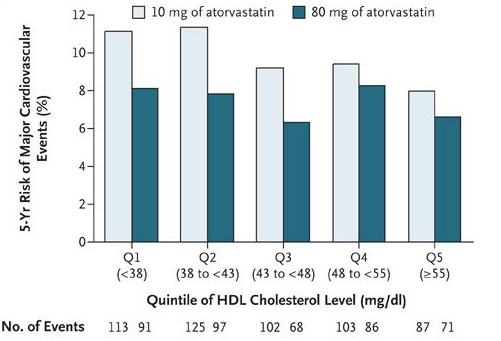
Take a look at Figure 1: Higher doses of Lipitor only made a big difference in risk when HDL levels were low. As HDL levels rose, the difference in height between the light- and dark-green bars went down. This means that if a person can get his or her “good” cholesterol high enough, higher doses of Lipitor will NOT necessarily decrease the risk of having a cardiovascular event.
This finding ties in well with the second question: What role do these other numbers play in cardiovascular health? From the NEJM study, we've seen that high HDL levels – which are a good thing – trump higher doses of Lipitor in preventing heart disease. But can adequate levels of “good” cholesterol also counterbalance the cardiovascular risk when “bad”cholesterol levels are high?
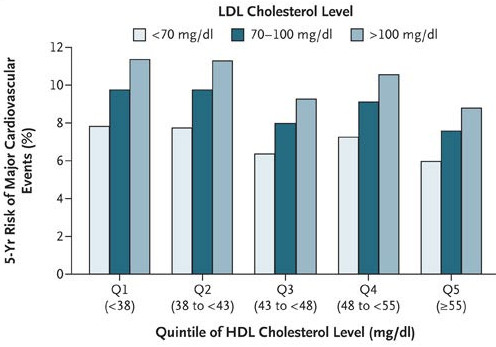
In a word, yes. Take a look at Figure 2: as HDL level increased, the risk of a cardiovascular
event decreased. But more surprising, if HDL and LDL levels were both high (above 55 and 100 mg/dL, respectively), a person had nearly equal risk of a major cardiovascular event as someone who had good LDLs (<70 mg/dL) but bad HDLs (<38 mg/dL)!
Similar evidence is mounting that high triglyceride levels are also an independent risk factor for heart disease. In fact, one study showed that even when people with a history of heart problems used statins to lower their LDLs to acceptable levels, slight increases in triglyceride levels significantly increased the chance they'd have another cardiovascular event.
So there is evidence that the other lipids in the blood (HDL and triglycerides) are equally important in predicting heart health. So is it possible to raise your HDL, or lower your triglyceride, levels? You bet. Studies have shown that simple, endurance exercise training significantly decreases triglyceride levels and raises HDL levels in many people.
I'm not saying that diet and exercise changes will work for everyone. But statins shouldn't be viewed as the magic bullet, either. As more studies on the science of exercise emerge, we'll begin to move past the notion that exercise simply burns calories, and deepen our understanding of the complex interactions of physical activity and metabolism.
Will Keas Live Up To Its Potential?
"The human body does enormously well healing itself," Keas founder, and ex-Google Health lead, Adam Bosworth told Health 2.0 conference-goers shortly after stepping on stage. On the heels of an article in the New York Times that touted the company's beta launch, Bosworth walked the crowd through the way we'll keep ourselves healthy in the future, using Keas' platform.
"The human body does enormously well healing itself," Keas founder, and ex-Google Health lead, Adam Bosworth told Health 2.0 conference-goers shortly after stepping on stage. On the heels of an article in the New York Times that touted the company's beta launch, Bosworth walked the crowd through the way we'll keep ourselves healthy in the future, using Keas' platform.
Over the past few years, Bosworth carefully watched as the Health 2.0 revolution unfolded. Medical issues became less of a private experience. People, who at one time only discussed personal ailments with their family physician, now turned to family and trusted friends for medical advice. With the boom of the Internet, a person's trusted medical community suddenly became infinite.
Of all people, Bosworth understood the potential power of the internet on health, where the collective wisdom of the patient population could reach thousands, or millions, of other people. So he wondered, if people were readily turning to the web for information when they got sick, could customized, preemptive web advice keep people from getting sick in the first place?
Keas' system uses custom "Care Plans" that collect personal data that the user either uploads at the website, or is transferred directly from a lab, like Quest Diagnotics. Keas plans to run its own iPhone-like App Store, where doctors or other health care providers create their own Care Plans, integrate them into the Keas platform, and instantly distribute them to millions of people.
By personalizing the measures we can take to stave off certain predisposed conditions, Keas' Care Plans should improve our health. But the real promise of the company, wasn't in what Bosworth delivered onstage, but rather, in something he simply mentioned in passing. Bosworth alluded to the idea that not only will Keas' platform let people track their own health, but it could also allow people to keep tabs on their family's health as well.
Imagine logging into your Keas profile, and being presented with a dashboard that shows the current health information for your spouse, child, and elderly parent. Did your husband get his blood work test today? How much has your child exercised? Has your 80-year-old father read the online information packet on "Preventing Falls in the Home"? At a glance, you'd have this information in front of you on the Keas website, if the company follows through with this idea.
When people become chronically ill, or simply start living into their eighties and nineties, maintaining health shifts from an individual to a team sport. There's too much information for one person to process and comprehend. Too many medications. Too many things to keep straight. Current estimates put 30 million people in the US as primary caregivers -- adults, aged 18 or over, who maintain the personal well-being of another adult. Keas' program has the potential to make the term "long-distance caregiver' obsolete. Everyone would be just a click away from checking-in with their loved ones.
To Get Rid of the Diseases Mosquitoes Carry, Feed the Bugs Bacteria
I saw this study in Science at the beginning of the month, and a summary was posted at The Scientist:
A bacterium that infects insects may provide a biological method for stunting the spread of a range of devastating human diseases. The bacteria may protect their hosts against disease-causing pathogens by hiking up the insects' immune response, according to a study published online today (October 1) in Science.

I saw this study in Science at the beginning of the month, and a summary was posted at The Scientist:
A bacterium that infects insects may provide a biological method for stunting the spread of a range of devastating human diseases. The bacteria may protect their hosts against disease-causing pathogens by hiking up the insects' immune response, according to a study published online today (October 1) in Science.
Basically, mosquitoes were fed a certain bacteria, called "popcorn" Wolbachia, that did two things, 1.) boosted the immune system of the mosquitoes, which made them less likely carriers of diseases such as filarial nematodes (cause lymphatic filariasis), and 2.) cut the average lifespan of the mosquitoes in half.
Researchers are looking at the future possibilities of this promising treatment -- a natural way to curb the dangerous infectious diseases spread by mosquitoes. Questions remain whether the "popcorn" bacteria could also interfere with the mosquitoes' ability to carry more dangerous diseases, such as malaria or the Dengue virus.