PepsiCo at ScienceBlogs
ScienceBlogs.com -- one of the most well-known and highly-cited blog sites -- caused quite the hullabaloo on Twitter and the blogosphere today when they announced their newest contributor: PepsiCo. For quite some time, SEED Media (the parent company behind ScienceBlogs.com) has sold advertising space on contributors' sites. But as PalMD describes in his post, the center panel of each site is always under the direct control of the author. With the launch of the PepsiCo blog, SEED Media is in grave danger of blurring the line between advertising and content.
ScienceBlogs.com -- one of the most well-known and highly-cited blog sites -- caused quite the hullabaloo on Twitter and the blogosphere today when they announced their newest contributor: PepsiCo. For quite some time, SEED Media (the parent company behind ScienceBlogs.com) has sold advertising space on contributors' sites. But as PalMD describes in his post, the center panel of each site is always under the direct control of the author. With the launch of the PepsiCo blog, SEED Media is in grave danger of blurring the line between advertising and content.
I don't think there is anything inherently wrong with selling ad space on the periphery of popular blog platforms. Everyone has to pay the bills, and SEED Media needs a revenue stream to distribute and market its content. But I'm not exactly sure how PepsiCo will use its newly launched blog, now that it has control of that valuable "center panel". Only time will tell whether the PepsiCo blog will become a PR platform for the food conglomerate, or whether they'll actually contribute to scientific discourse.
Whether we like it or not, the prepared food industry will be a major player in our food supply in the near future. We need to find novel ways to engage these companies to improve health and nutrition in society. Hopefully, PepsiCo takes this opportunity to contribute in the exchange of scientific information, and doesn't just focus on improving sales.
I'll be watching this site very closely over the next few months, and I'll report on what I find.
Slate Reports on Different Types of LDLs
As a follow-up to my post "The Truth About Cholesterol", here's a report from Slate showing that all LDLs are not created equal, and some types are more dangerous than others. Moreover, the article discusses how America's "War on Fat" steered us away from butter and lard, but led us to an arguably more dangerous food, the refined carbohydrate. Post your thoughts!
As a follow-up to my post "The Truth About Cholesterol", here's a report from Slate showing that all LDLs are not created equal, and some types are more dangerous than others. Moreover, the article discusses how America's "War on Fat" steered us away from butter and lard, but led us to an arguably more dangerous food, the refined carbohydrate. Post your thoughts!
Sugar-coated Laziness
Check out this study. Researchers found that when "teenage" rats (30-45 days old) consumed massive amounts of sugar, they became extremely difficult to train as adults. For two weeks or so during adolescence, one group of rats had free access to a tasty 5% sucrose solution, while the control group only had water available. Similar to some American teenagers, the experimental group of rats consumed about 20% of their daily caloric intake as simple sugar.
Check out this study. Researchers found that when "teenage" rats (30-45 days old) consumed massive amounts of sugar, they became extremely difficult to train as adults. For two weeks or so during adolescence, one group of rats had free access to a tasty 5% sucrose solution, while the control group only had water available. Similar to some American teenagers, the experimental group of rats consumed about 20% of their daily caloric intake as simple sugar.
To give you some background, it's extremely easy to train adult rats to perform simple tasks, such as pulling levers or pressing buttons in return for a food reward. However, the researchers couldn't motivate the rats that had consumed large amounts of sugar as teenagers to learn the task. My first reaction while reading this paper was: "Big deal. That group of rats just had sugar overload. It no longer had any real value for them, so there was no incentive to learn the new task".
But here's where the story gets interesting: if you repeat the experiment, but replace the teenage rats with adult rats, you get strikingly different results. When adult rats have free access to a sugary drink for two weeks, they never lose motivation for the sweet reward, and easily learn the new lever-pull task later in life. So it's not that rats are simply sick of the sweet reward, but rather, it seems the sweet drink over-stimulated the reward pathway in the brain during adolescent development, leading to problems with motivation in adulthood.
Were the calories in the sugary drink or the sweet taste to blame for hyper-activating the reward circuits in the brain? To answer this, the authors took another group of teenage rats and gave them free access to a drink flavored with artificial sweetener, which has no calories. These rats were also unmotivated and rather difficult to train later in life, so the authors concluded that the sweet taste, but not the sugar itself, was hyper-activating the brain's reward circuits.
Besides, ahem, crazy neuroscientists writing for health blogs, who cares about lazy rats? Well, the authors argue that a sign of depression in rodents is lack of motivation to perform simple tasks. Given that incidence rates for depression and other psychological illness are increasing in today's society, it's interesting to see how seemingly benign events during adolescence -- a critical time in brain development -- affect the mental state of adult animals.
The Truth About Cholesterol
We've all heard the mantra: keep LDL levels – the “bad” cholesterol – down, and the “good” HDL cholesterol up. But thanks in part to the ubiquity of statins, such as Lipitor, which allow us to simply pop a pill to limit LDL production in the body, we've recently adopted tunnel vision when thinking about managing cholesterol. LDL levels are all we seem to care about now, as we strive for lower and lower numbers at each visit to the doctor's office. However, I think we're missing the bigger picture by focusing solely on LDL. First, it's made us reliant on medication to solve a problem that can many times be addressed with changes in diet and exercise regimes. Once someone starts Lipitor treatment, they'll be taking it for life, and if LDL levels don't quite get as low as they should, it's all too easy to solve the problem by increasing the dose. When patients first begin Lipitor treatment, physicians typically prescribe the lowest possible amount, 10mg. However, dosing can go as high as 80mg, which begs the question: Do higher doses of the drug really improve outcomes?
We've all heard the mantra: keep LDL levels – the “bad” cholesterol – down, and the “good” HDL cholesterol up. But thanks in part to the ubiquity of statins, such as Lipitor, which allow us to simply pop a pill to limit LDL production in the body, we've recently adopted tunnel vision when thinking about managing cholesterol. LDL levels are all we seem to care about now, as we strive for lower and lower numbers at each visit to the doctor's office. However, I think we're missing the bigger picture by focusing solely on LDL. First, it's made us reliant on medication to solve a problem that can many times be addressed with changes in diet and exercise regimes. Once someone starts Lipitor treatment, they'll be taking it for life, and if LDL levels don't quite get as low as they should, it's all too easy to solve the problem by increasing the dose. When patients first begin Lipitor treatment, physicians typically prescribe the lowest possible amount, 10mg. However, dosing can go as high as 80mg, which begs the question: Do higher doses of the drug really improve outcomes?
Second, the LDL value doesn't tell the whole story. After all, some people that have low LDL levels, still develop heart disease. When your doctor orders a standard lipid panel, LDLs are measured along with other lipids, such as high-density lipoprotein (HDL) cholesterol and triglycerides. What role do these other types of lipids play in cardiovascular health?
Let's start with the first question: Do higher doses of the drug really improve outcomes? This idea popped into my mind while reading a recent study in PLoS One that looked at LDL levels in patients diagnosed with familial hypercholesterolemia, a genetic predisposition to high levels of “bad” cholesterol. Caused by specific DNA mutations on a small region of chromosome 19, familial hypercholesterolemia drastically increases the chances that a person will develop heart disease. In fact, studies estimate that 85% of men with this mutation will have a heart attack by the age of 60.
The PLoS study found that only a minority of people with hypercholesterolemia brought their LDL levels down to recommended values, even when using statins. According to the authors, doctors were being too cautious with Lipitor dosing, and felt that higher doses would help patients reach their LDL targets.
Blood....beginning....to....boil.....
I know this isn't the first time I've climbed up on my soapbox saying “more medication is not always the answer”, but I wanted to find proof. Lo and behold, I came across a good study from the New England Journal of Medicine that calculated the risk of a major cardiovascular event depending on whether people were taking low- or high-doses of Lipitor (10 or 80 mg, respectively).
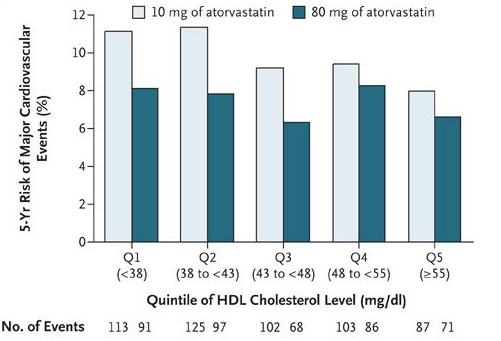
Take a look at Figure 1: Higher doses of Lipitor only made a big difference in risk when HDL levels were low. As HDL levels rose, the difference in height between the light- and dark-green bars went down. This means that if a person can get his or her “good” cholesterol high enough, higher doses of Lipitor will NOT necessarily decrease the risk of having a cardiovascular event.
This finding ties in well with the second question: What role do these other numbers play in cardiovascular health? From the NEJM study, we've seen that high HDL levels – which are a good thing – trump higher doses of Lipitor in preventing heart disease. But can adequate levels of “good” cholesterol also counterbalance the cardiovascular risk when “bad”cholesterol levels are high?
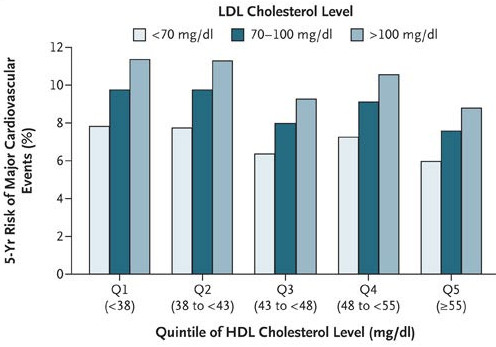
In a word, yes. Take a look at Figure 2: as HDL level increased, the risk of a cardiovascular
event decreased. But more surprising, if HDL and LDL levels were both high (above 55 and 100 mg/dL, respectively), a person had nearly equal risk of a major cardiovascular event as someone who had good LDLs (<70 mg/dL) but bad HDLs (<38 mg/dL)!
Similar evidence is mounting that high triglyceride levels are also an independent risk factor for heart disease. In fact, one study showed that even when people with a history of heart problems used statins to lower their LDLs to acceptable levels, slight increases in triglyceride levels significantly increased the chance they'd have another cardiovascular event.
So there is evidence that the other lipids in the blood (HDL and triglycerides) are equally important in predicting heart health. So is it possible to raise your HDL, or lower your triglyceride, levels? You bet. Studies have shown that simple, endurance exercise training significantly decreases triglyceride levels and raises HDL levels in many people.
I'm not saying that diet and exercise changes will work for everyone. But statins shouldn't be viewed as the magic bullet, either. As more studies on the science of exercise emerge, we'll begin to move past the notion that exercise simply burns calories, and deepen our understanding of the complex interactions of physical activity and metabolism.
Can High Blood Glucose Levels Cause Cancer?
Diets high in simple sugars and refined carbs cause metabolic disorders and Type II diabetes in millions of Americans. But to make matters worse, new evidence suggests that high sugar diets may be even more dangerous than we initially thought. Having too much excess sugar in the bloodstream is never a good thing, and can lead to medical complications such as kidney failure, cardiovascular disease, and eye problems. But could high blood sugar also cause cancer? A Swedish research team addressed this question by tracking over 500,000 patients for 10-25 yeas, and published their results in the December issue of PLoS Medicine.
Diets high in simple sugars and refined carbs cause metabolic disorders and Type II diabetes in millions of Americans. But to make matters worse, new evidence suggests that high sugar diets may be even more dangerous than we initially thought. Having too much excess sugar in the bloodstream is never a good thing, and can lead to medical complications such as kidney failure, cardiovascular disease, and eye problems. But could high blood sugar also cause cancer? A Swedish research team addressed this question by tracking over 500,000 patients for 10-25 yeas, and published their results in the December issue of PLoS Medicine.
Similar to the findings of a study conducted in Korea in 2005, the European research team discovered that having elevated blood glucose levels increased the risk of developing certain types cancer later in life, such as pancreatic tumors in women and liver tumors in men. Not only had more cases of cancer occurred when people had high blood sugar, but the chance of survival also plummeted, especially when the person had cervical, espohageal, or colorectal cancers.
The authors present two theories on why elevated blood glucose levels could cause cancer: 1.) high sugar diets may cause an overproduction of insulin or insulin-like growth factor 1 (IGF-1), both of which promote rapid growth of new cells, the catalyzing step to tumor formation. 2.) More glucose in the blood stream could simply be adding fuel to the fire, feeding rogue tumor cells that need lots of energy to run.
Because the studies lacked certain controls, we can't say for sure whether elevated blood glucose levels cause certain tumors to form. For example, the people with high blood glucose levels may have been sedentary, and so the lack of exercise may be what's actually increasing the chances of developing cancer. Regardless, this study gives yet another example of unhealthy lifestyles contributing to comorbidity, a topic discussed at length by Thomas in The Decision Tree book.
Behavior Change: A Central Topic at Health 2.0
The afternoon of Day 1 of the Health 2.0 Conference was highlighted by the session, "The Patient is In". First up, a video that documented the experiences of a group of people that recently started using patient health tools, such as online health journals that track diet or exercise, support sites for quitting smoking, or home blood test kits.

The afternoon of Day 1 of the Health 2.0 Conference was highlighted by the session, "The Patient is In". First up, a video that documented the experiences of a group of people that recently started using patient health tools, such as online health journals that track diet or exercise, support sites for quitting smoking, or home blood test kits.
Following the video, a few of the participants were joined onstage by technology pioneer Esther Dyson. Some panelists said that while they exercised a bit more and ate somewhat better during the course of the experiment, soon after they returned to their old (bad) habits. Others were completely sold on the idea of self-tracking, and one particular panelist said that his daily running and mile-logging inspired his daughter and her friend to do the same. Likewise, his neighbor, having noticed him trotting around the neighborhood several times a week, started his own walking regiment. In the panelist's words, "People draw energy from supportive environments".
Social contagion, the idea that behavior change can be contagious, has been gaining ground. A few months ago, I experienced the power of social contagion for myself: as many readers know, I'm a long-time runner. But no matter how many miles I logged per week, my wife never really understood why I was out on the road, tormenting myself for hours. It wasn't until she bought a Nike+ sensor, and her boss challenged her to a "See Who Can Run More Miles in a Month" challenge that she became hooked on running. Now I have to spy on her website running log to make sure I still run more miles per week (yes, I'm competitive too).
Some people are inspired to change their behaviors by logging how many calories they're consuming every day. Others are motivated by seeing friends or family stop smoking. And for some, it takes someone else to throw down the gauntlet, and say, "I bet I can kick your butt in a race around the track" for the change to occur.
Esther Dyson concluded the session by saying that we can also drive behavior changes by associating the things we just don't like to do with small "rewards". Personally, she rewarded the monotony of flossing with a 5-minute reprieve from her intense exercise routine. So on days she flossed, instead of swimming for an hour, she could quit after 55 minutes.
Social contagion and little rewards go a long way in keeping people focused and motivated, and I was glad to see these ideas brought up at today's conference.
What the NYT and Slate Don't Seem to Understand About Behavior Change
Two articles posted online got under my skin this morning, and I just couldn't resist giving my two cents. First, Tara Parker-Pope, of the New York Times says:
Most obesity researchers now agree that metabolic differences, not willpower, are the driving forces behind weight and appetite control. Studies suggest that an imbalance of brain chemicals and hormones, including cortisol, ghrelin, leptin and serotonin, can increase cravings and make certain foods difficult to resist.
Two articles posted online got under my skin this morning, and I just couldn't resist giving my two cents. First, Tara Parker-Pope, of the New York Times says:
Most obesity researchers now agree that metabolic differences, not willpower, are the driving forces behind weight and appetite control. Studies suggest that an imbalance of brain chemicals and hormones, including cortisol, ghrelin, leptin and serotonin, can increase cravings and make certain foods difficult to resist.
Next, Slate's Engber rants:
It's ironic that so many advocates for healthy eating are also outspoken gourmands. Alice Waters, the proprietor of Chez Panisse, calls for a "delicious revolution" of low-fat, low-sugar lunch programs. It's a central dogma of the organic movement that you can be a foodie and a health nut at the same time—that what's real and natural tastes better, anyway. Never mind how much fat and sugar and salt you'll get from a Wabash Cannonball and a slice of pain au levain. Forget that cuisiniers have for centuries been catering to our hedonic hunger—our pleasure-seeking, caveman selves—with a repertoire of batters and sauces. Junk foods are hyperpalatable. Whole Foods is delicious. Doughnuts are a drug; brioche is a treat.
Tara Parker-Pope misses the fact that personal choices (i.e. what she calls 'willpower') directly affect metabolism. Numerous studies have shown that exercise and calorie restriction (aka 'diet') alter the metabolism of our muscle and fat cells, as well as improve cells' resistance to insulin.
High-sugar, high-fat foods are hard to resist no matter who you are. Most of the in-shape people I know have numerous overweight and/or obese relatives. No, these people weren't simply handed the better genes, rather they are in-shape because they constantly bust their ass. They exercise like crazy. At dessert, they pass up the chocolate cake, and take the fruit cup. When they're hungry during the day, they choose a sensible snack as opposed to raiding the company vending machine. These people are not super-heroes. They have spouses and kids. And at the end of a long day they're tired, just like the rest of us. So what keeps them going? Deep down, they know if they stop, they'll just become another statistic. So they pass up that extra half hour of sleep to hit the road for a run at the crack of dawn.
Willpower leads to behavior changes which lead to metabolic alterations; they're not mutually exclusive. Sure, most dieters will never see the drastic results accomplished by participants of 'The Biggest Loser', but Parker-Pope just gave them a reason to not even make the attempt.
As for Engber's article on Slate, he completely overlooks one not-so-little issue: serving size. American fast-food and junk food is packaged in ridiculously-sized (and calorie-laden) servings. I'll bet the farm that the last time you dined at a gourmet restaurant, the waiter didn't ask if you would like to 'Super-Size' your duck confit entree.
Despite my frustration, I agree with Engber on two points: 1.) a fat-tax on sugary beverages and junk food is not the answer to America's health woes, and 2.) such a tax would end up hurting the poor more than anyone else. The differences in price between fresh fruits and vegetables and fast-food/junk-food is really a separate, much larger problem that I'm not going to get into right now.
In both articles, what irks me the most is that we are currently faced with an obesity epidemic. People really don't need to read articles that marginalize the behavior changes that science has shown will make us healthier.
Cheeseburgers on the Mind
Making a choice that leads to better health is not always easy. Otherwise, we would have many more ex-smokers and far fewer holiday pounds to shed. We would have no need for nicotine gum and patches, or Weight Watcher's meetings. So if it's that difficult, why bother? For years, physicians have told the American public that reducing your calorie intake, eating a diet low in salt/sugar/saturated fat, and exercising 3-5 days per week will reduce your risk for heart disease and diabetes. Now, new information has shown that the benefits of a healthy lifestyle are even more far reaching than initially thought -- diet and exercise can affect our minds. About 5-8% of people over the age of 65, and nearly 50% of people in their 80's, show signs of dementia. As the baby-boomer generation increases the population of the 55-64 age group in the U.S. from 29 to 40 million by 2014 , and their life expectancy continues to rise, the number of people affected by dementia is poised to increase as well. Recent studies have shown that regular exercise may prove to be a potent mediator of dementia and Alzheimer's Disease. In one study, those who exercised 3 or more days per week had a 32% risk reduction in developing dementia compared to those who exercised less. Exercise has also been linked in similar studies to moderate cognitive improvements in adults who are at risk for Alzheimer's Disease, as well as a lower occurrence of vascular dementia.
Making a choice that leads to better health is not always easy. Otherwise, we would have many more ex-smokers and far fewer holiday pounds to shed. We would have no need for nicotine gum and patches, or Weight Watcher's meetings. So if it's that difficult, why bother? For years, physicians have told the American public that reducing your calorie intake, eating a diet low in salt/sugar/saturated fat, and exercising 3-5 days per week will reduce your risk for heart disease and diabetes. Now, new information has shown that the benefits of a healthy lifestyle are even more far reaching than initially thought -- diet and exercise can affect our minds. About 5-8% of people over the age of 65, and nearly 50% of people in their 80's, show signs of dementia. As the baby-boomer generation increases the population of the 55-64 age group in the U.S. from 29 to 40 million by 2014 , and their life expectancy continues to rise, the number of people affected by dementia is poised to increase as well. Recent studies have shown that regular exercise may prove to be a potent mediator of dementia and Alzheimer's Disease. In one study, those who exercised 3 or more days per week had a 32% risk reduction in developing dementia compared to those who exercised less. Exercise has also been linked in similar studies to moderate cognitive improvements in adults who are at risk for Alzheimer's Disease, as well as a lower occurrence of vascular dementia.
Recent pre-clinical results have shown that diet is also tied to brain health. A 2002 study revealed that rats fed a diet high in saturated fat and refined sugar for 2 years exhibited changes in both gene expression in the brain, as well as performance on a memory task (finding its way through a water maze). This fast-food type diet decreased the levels of brain-derived neurotrophic factor (BDNF), which is a versatile molecule that mediates brain cell formation, function, and survival. Both BDNF gene expression (mRNA) and BDNF protein production in the hippocampus, an area crucial for short-term memory, were significantly reduced in the animals fed the high-fat and refined sugar diet, compared to those on a low-fat, complex carbohydrate diet. Although the experiment lasted for 2 years, and the greatest effects were seen at the end of the experiment, changes in gene expression were seen in as little as 6 months after the rats began downing cheeseburgers. Even more striking, the rats had a significant deficit in the water maze memory task after only 3 months on the high fat/sugar diet, which shows that the "McDiet" led to a change in behavior in the mice.
Nevertheless, the research presented here had limitations. The studies that looked at the effects of exercise on dementia were conducted in relatively small, non-diverse human populations and were not completely controlled against other "good health" factors that tend to occur when people exercise. For example, exercisers are much more likely to do other healthy things, such as eating right, quitting smoking, getting quality sleep, or maintaining target weight. The fast-food diet study was well controlled to show that decreased BDNF was not related to hypertension, atherosclerosis, obesity, and changes in activity level -- but the results must be taken at face value since it was conducted in rodents, not humans.
So what does all of this mean? The idea of eating right and getting more exercise is nothing new. We've known for years that changing our health behaviors can stave off heart disease, and potentially let us live longer. The studies mentioned here really highlight the positive-feedback nature of our actions -- behavior changes (diet and exercise) cause physiological and molecular changes in the body, which in turn alter another behavior (memory). This relationship tells us that our behavior choices no longer only determine life or death, but they also can impact our quality of life. It's true that the results don't make a direct link between diet/exercise and brain health, but rather, a loose correlation between the two that requires further study. But in my mind, it doesn't really matter what keeps the brain healthy -- my point isn't that diet and exercise are the end-all cure for disease, but rather, that they are an extremely important part of an overall healthy lifestyle that will allow us to make the most of our golden years.