Using Blood Pressure Cuffs to Enhance Sports Performance
Over at Wired Playbook, I have a new article highlighting a sports performance-enhancing technique where blood flow is temporarily reduced to a limb, in order to prime the muscle for future stress during exercise:

Over at Wired Playbook, I have a new article highlighting a sports performance-enhancing technique where blood flow is temporarily reduced to a limb, in order to prime the muscle for future stress during exercise:
The study builds off research first conducted in the 1980s by cardiovascular pioneer Keith Reimer that examined infarcts, areas of dead cardiac tissue that resulted after heart attacks, when blood flow (and, hence, oxygen) were cut off for extended periods of time. Reimer and his colleagues discovered that much less heart muscle deteriorated when the tissue had previously experienced a few training sessions where blood flow was slightly reduced.
It was as if practice makes perfect, and the previous bouts of low blood flow, which researchers refer to as ischemic preconditioning, primed the heart muscle to endure more serious, even catastrophic, events. When a life-threatening heart attack transpired, instead of shriveling away, the preconditioned heart muscle seemed to stand strong.
Read the full story here.
Photo via Flickr / jasleen_kaur

Jean-St-Michel E, Manlhiot C, Li J, Tropak M, Michelsen MM, Schmidt MR, McCrindle BW, Wells GD, & Redington AN (2010). Remote Preconditioning Improves Maximal Performance in Highly-Trained Athletes. Medicine and science in sports and exercise PMID: 21131871
Can Asthma Inhalers Enhance Athletic Performance?
My latest story for Wired Playbook highlights new research that investigates whether the common asthma medication, salbutamol/albuterol, could enhance athletic performance when taken in extremely large doses.
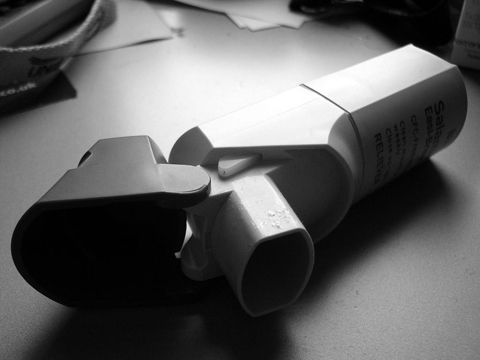
My latest story for Wired Playbook highlights new research that investigates whether the common asthma medication, salbutamol/albuterol, could enhance athletic performance when taken in extremely large doses.
A research team led by Jimmi Elers at the Respiratory Research Unit at Bispebjerg Hospital in Copenhagen was curious: Although taking a few puffs of salbutamol hasn’t shown a performance boost in past studies, what would a dose that’s, say, 40 times higher than normal do to lung function? And with higher amounts of the drug running through their bodies, would the over-the-top dose cause athletes to hit the upper limit enforced by the new WADA standards when they’re forced to undergo a urine-screening test before competition?
Image via Flickr / Neil T

Elers, J., Mørkeberg, J., Jansen, T., Belhage, B., & Backer, V. (2010). High-dose inhaled salbutamol has no acute effects on aerobic capacity or oxygen uptake kinetics in healthy trained men Scandinavian Journal of Medicine & Science in Sports DOI: 10.1111/j.1600-0838.2010.01251.x