PLoS Blogs Launches
Greetings from London, where I’ll be situated for the next few days. I’m here to attend the Science Online London 2010 conference on Friday and Saturday, representing PLoS. I’m happy to announce that yesterday we announced the launch of a grand new endeavor, a scientific blog network, PLoS Blogs. As the resident community manager (and avid in-house proponent of PLoS getting into the blogging scene), I’ve been tapped to manage this group as well.

Greetings from London, where I’ll be situated for the next few days. I’m here to attend the Science Online London 2010 conference on Friday and Saturday, representing PLoS. I’m happy to announce that yesterday we announced the launch of a grand new endeavor, a scientific blog network, PLoS Blogs. As the resident community manager (and avid in-house proponent of PLoS getting into the blogging scene), I’ve been tapped to manage this group as well.
We have a fantastic lineup of bloggers, which include a Pulitzer Prize winner (Deborah Blum), the former editor-in-chief of Scientific American (John Rennie), science journalist powerhouses (Steve Silberman, Emily Anthes, and Melinda Wenner Moyer), and top researchers (David Kroll, Travis Saunders & Peter Janiszewski, Greg Downey & Daniel Lende, Misha Angrist, Sarah Kavassalis, Martin Fenner).
You can read my launch post over there in full, where I talk about PLoS’ reason for doing this, our vision, and my thoughts on the future of science blog networks:
There’s been a lot of chatter in the blogosphere that any networks that spawn in the wake of #SbFAIL have to be one flavor or another: If you’re an organization, you’re only going to recruit writers with large, notable brands; on the flip side, if you’re a smaller grass-roots network, you won’t be able to snag those big names in the first place.
We weren’t quite sure how PLoS squared with this logic. We’re not a deep-pocketed corporate organization, but we certainly have a well-respected brand. We embody a certain grass-roots vibe, yet we have strong technical, administrative, and marketing support.
I guess the most important lesson we’ve learned in the past six weeks is that theory goes out the window when you actually set out to build a network. We didn’t want to become another ScienceBlogs, or another Discover Blogs, for that matter. So we finally said screw it and did our own thing. We set out to create our own niche network.
This is an exciting new endeavor for PLoS and the team over there has really busted their butts for the past weeks getting this thing up and running, especially my boss, Sara Wood, and our jack-of-all-trades web engineer, Russ Uman.
Please do check out the site. And send your comments along to me:
brian.mossop[at]gmail[dot]com
bmossop[at]plos[dot]org
Curiosity as Vice and Virtue
Copernicus and Galileo had it easy. Those two lived during the middle of the European Renaissance, a time when creativity and curiosity were norms in society. Sure, the church came down hard on their views on where the earth stood in relation to the rest of the universe. But, basically, the church simply disagreed with the details of their argument. (Well, I guess calling someone a heretic is slightly more than disagreeing with someone, but you know what I mean...)
Copernicus and Galileo had it easy. Those two lived during the middle of the European Renaissance, a time when creativity and curiosity were norms in society. Sure, the church came down hard on their views on where the earth stood in relation to the rest of the universe. But, basically, the church simply disagreed with the details of their argument. (Well, I guess calling someone a heretic is slightly more than disagreeing with someone, but you know what I mean...)
The scientific minds who really had rough run-ins with the church lived during the fourth century, under the moral guidance of Augustine, the Catholic archbishop of Hippo. At that time, science was a sin, as Augustine likened inquisitiveness to a form of lust. Not a "lust of the flesh", but more of a "lust to find out and know". According to author, William Eamon, Augustine saw no difference between people-watching at the circus or the piazzas and enduring the rigors of scientific study. Check out the rest of Eamon's fascinating analysis here.
Science Rock Stars
In a recent post, I talked about the dangers of celebrities promoting pseudoscience. Well, maybe the celebrities have redeemed themselves. GQ featured a pictorial of scientists kicking it with rock stars such as Joe Perry and Sheryl Crow, aimed to raise public awareness of important medical and scientific research.
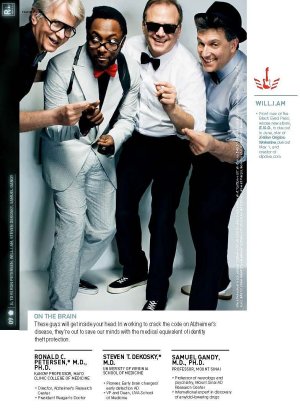
In a recent post, I talked about the dangers of celebrities promoting pseudoscience. Well, maybe the celebrities have redeemed themselves. GQ featured a pictorial of scientists kicking it with rock stars such as Joe Perry and Sheryl Crow, aimed to raise public awareness of important medical and scientific research.
Not since will.i.am of the Black Eyed Peas appeared via hologram (seriously) to talk to CNN's Anderson Cooper during the 2008 Presidential Election, has the rock & roll establishment nerded-out so much. But I applaud this effort to break down the stereotypes of scientists. Despite common misconceptions, we too have a sense of humor and can have fun. Enjoy.