CDC prepares US for zombie attack (and other disasters)
How can the CDC make public health campaigns sexier? One way: to release a top-ten list of the greatest achievements in public health, from triumphs over vaccine-preventable diseases to the boon in tobacco control programs.

How can the CDC make public health campaigns sexier? One way: to release a top-ten list of the greatest achievements in public health, from triumphs over vaccine-preventable diseases to the boon in tobacco control programs.
The other: instead of releasing the dry, stale prose of a disaster preparedness fact sheet, build a website that tells people how to protect themselves from “zombies…or hurricanes or pandemics.”
The New York Times reported on the creative initiative by the CDC intended to get people’s attention, and get them ready for a disaster. And so far, it’s been doing quite well:
The blog post went up on Monday. “A typical post gets 1,000 hits,” Mr. Daigle said. “We got 10,000, then 30,000 on Tuesday, and then it crashed the server.”
Score one for the CDC on public engagement.
Photo via Flickr / aeviin
Brian Mossop is currently the Community Editor at Wired, where he works across the brand, both magazine and website, to build and maintain strong social communities. Brian received a BS in Electrical Engineering from Lafayette College, and a PhD in Biomedical Engineering from Duke University in 2006. His postdoctoral work was in neuroscience at UCSF and Genentech.
Brian has written about science for Wired, Scientific American, Slate, Scientific American MIND, and elsewhere. He primarily cover topics on neuroscience, development, behavior change, and health.
Contact Brian at brian.mossop@gmail.com, on Twitter (@bmossop), or visit his personal website.
Peanut allergies and blood transfusions
Donated blood is routinely screened for dangerous pathogens – things like HIV and Hepatitis – to make sure there is no threat to the recipient’s health during a transfusion. But a case study just published in The New England Journal of Medicine suggests that viruses are not the only hazards lurking in the collection bag.
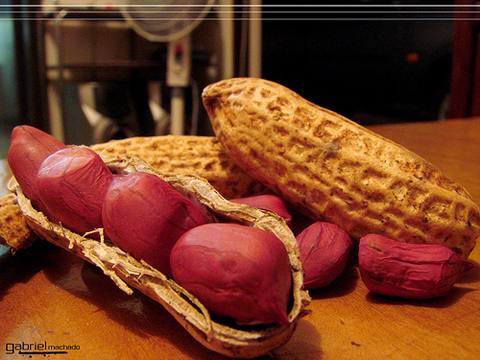
Donated blood is routinely screened for dangerous pathogens – things like HIV and Hepatitis – to make sure there is no threat to the recipient’s health during a transfusion. But a case study just published in The New England Journal of Medicine suggests that viruses are not the only hazards lurking in the collection bag.
The authors of the paper, a physician team from The Netherlands, reported that during a blood transfusion, the 6-year-old recipient suddenly burst out in a rash and started having difficulty breathing. Recognizing the boy was having an anaphylactic reaction, the doctors rescued him with a syringe of adrenaline.
The patient was definitely allergic to something, but quick tests showed that it was not due to latex glove sensitivity or an adverse reaction to a drug. Upon questioning, the boy’s mother recalled that he had a similar reaction after eating a few peanuts a few years back.
Immediately, the doctors began testing the boy’s blood, to see if he had antibodies to the peanut peptides circulating through his body, a measure that would determine if he had been exposed to the allergen that had made him sick in the past. Though his mother confirmed that he had not eaten a peanut in 5 years, the level of peanut peptide antibodies in his body was 200x higher than normal.
The doctors started to wonder: Could the blood the boy received somehow been tainted with peanut allergens?
While the peanut protein is rapidly digested, a 2009 study found that one of the legume’s smaller peptides, Ara h2, can stay in the bloodstream and saliva for up to 24 hours after eating. And confirming their suspicions, 3 out of 5 of the donors who contributed to bag of blood the boy received recalled snacking on several handfuls of peanuts the night before they donated.
Most hospitals tell donors to eat breakfast before arriving at the clinic, but they do advise people to stay away from certain foods – fatty grub like burgers, fries, and ice cream – that can interfere with the standard tests that labs use to make sure the blood isn’t infected. And while allergic reactions to blood transfusions are rare, the solution may be simple. Shouldn’t we at least consider adding peanuts to the list of foods people should avoid before donating blood?
Photo via Flickr
Brian Mossop is currently the Community Editor at Wired, where he works across the brand, both magazine and website, to build and maintain strong social communities. Brian received a BS in Electrical Engineering from Lafayette College, and a PhD in Biomedical Engineering from Duke University in 2006. His postdoctoral work was in neuroscience at UCSF and Genentech.
Brian has written about science for Wired, Scientific American, Slate, Scientific American MIND, and elsewhere. He primarily cover topics on neuroscience, development, behavior change, and health.
Contact Brian at brian.mossop@gmail.com, on Twitter (@bmossop), or visit his personal website.
Using Twitter to track flu outbreaks
When public health officials track the outbreak of a virus, like H1N1, it takes time to get the story right. They have to collect and assemble data from institutions scattered across the country, a process that can be, well, slow.
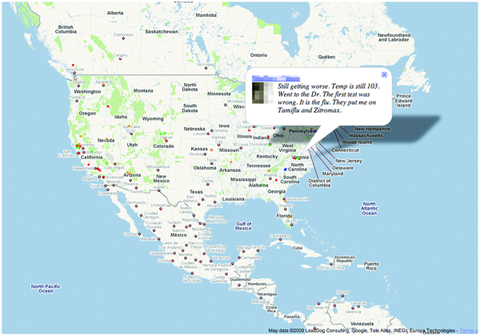
When public health officials track the outbreak of a virus, like H1N1, it takes time to get the story right. They have to collect and assemble data from institutions scattered across the country, a process that can be, well, slow.
For instance, at the CDC’s FluView website, you can see statistics for influenza trends across the country. But today’s “weekly influenza report” was assembled with data from the week ending 7 May 2011. Or put another way, the latest information is already 11 days old.
It seems crazy that sometimes the information we desperately need is the most difficult to get, but it’s all too often true. You can up-to-the-minute details on the location of your neighborhood’s taco truck, but if you want flu data, you’ll have to wait about 2 weeks.
The difference, of course, is that the food trucks have wholeheartedly embraced social media, which has quickened the pace of information flow. And as more and more people are using services like Twitter – which in 2010 was growing at a rate of 300,000 users each day – a savvy group of researchers from the University of Iowa wondered: if people are using Twitter to catalogue the minutia of their lives, could the tweets be analyzed to better track outbreaks of the flu?
Starting in April 2009, the research team led by Philip Polgreen, an assistant professor in the Department of Internal Medicine, starting logging tweets from users living in the US, and combed thru the data, filtering for certain keywords, like flu, swine, influenza, vaccine, H1N1, Tamiflu, etc.
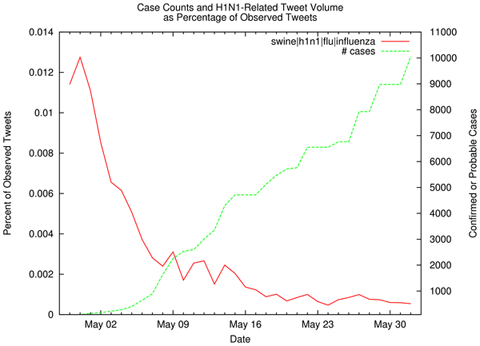
The first thing they noticed was that the general Twitter chatter about H1N1 peaked before the outbreak surfaced (check out the figure above). The red line represents the percentage of tweets talking about the flu or flu-like illness, while the green line shows the number of confirmed or probable cases. Whether this reflects an ability of social media to "predict" an outbreak remains unclear. But one thing's certain: people were aware of the storm that was brewing.
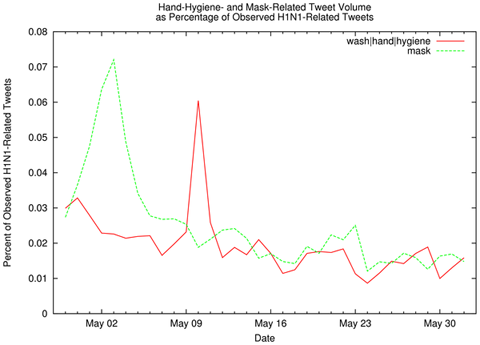
According to the study, in early May 2009, the CDC released targeted messaging to consumers about the importance of flu prevention. So when the team searched through the Twitter data for specific phrases like "mask" or "hand hygiene" they were able to gauge how prevention strategies were rippling through the virtual community. [Notice the two distinct peaks in Twitter traffic for "mask" (green line) and "hand hygiene" (red line) in the figure above.]
Seeing how Twitter chatter of certain keywords, however interesting it may be, doesn't do anything to address the larger problem, which is: How many people are infected with the flu at this very point in time? So the team devised a complicated statistical model to estimate the number of people infected with the flu based on their Twitter status. And surprisingly, when they compared their numbers (red line in figure below) to the count generated by the CDC (green line), they discovered the data were indistinguishable. However, they would have had the current estimates in hand a lot sooner than the CDC.
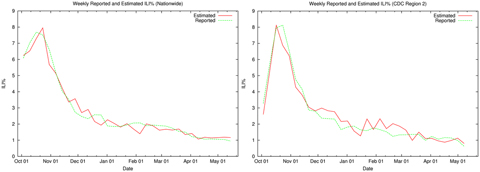
The authors acknowledge that their model needs to be validated by others. So consider this finding exactly what it is, a solid first step in a lengthy journey.
Citation: Signorini A, Segre AM, Polgreen PM, 2011 The Use of Twitter to Track Levels of Disease Activity and Public Concern in the U.S. during the Influenza A H1N1 Pandemic. PLoS ONE 6(5): e19467. doi:10.1371/journal.pone.0019467
Brian Mossop is currently the Community Editor at Wired, where he works across the brand, both magazine and website, to build and maintain strong social communities. Brian received a BS in Electrical Engineering from Lafayette College, and a PhD in Biomedical Engineering from Duke University in 2006. His postdoctoral work was in neuroscience at UCSF and Genentech.
Brian has written about science for Wired, Scientific American, Slate, Scientific American MIND, and elsewhere. He primarily cover topics on neuroscience, development, behavior change, and health.
Contact Brian at brian.mossop@gmail.com, on Twitter (@bmossop), or visit his personal website.
Fact-checking medical claims
In 2007/08, the work of Nicholas Christakis and James Fowler revealed that human behaviors, and even states of mind, tracked through social networks much like infectious disease.
Or put another way, both obesity and happiness worm their way into connected communities just like the latest internet meme, the best Charlie Sheen rumors, or the workplace gossip about Johnny falling down piss-drunk at the company’s holiday party.
In 2007/08, the work of Nicholas Christakis and James Fowler revealed that human behaviors, and even states of mind, tracked through social networks much like infectious disease.
Or put another way, both obesity and happiness worm their way into connected communities just like the latest internet meme, the best Charlie Sheen rumors, or the workplace gossip about Johnny falling down piss-drunk at the company’s holiday party.
But according to a new research study, incorrect medical facts may be no different, galloping from person to person, even within the confines of the revered peer-reviewed scientific literature. And by looking at how studies cite facts about the incubation periods of certain viruses, a new study in PLoS ONE has found that quite often, data assumed to be medical fact isn’t based on evidence at all.
How many glasses of water are we supposed to drink each day? Eight – everyone knows it’s eight. But according to researchers from the schools of Public Health and Medicine at Johns Hopkins University, this has never been proven true. In fact, they argue there’s not one single piece of data that supports this claim.
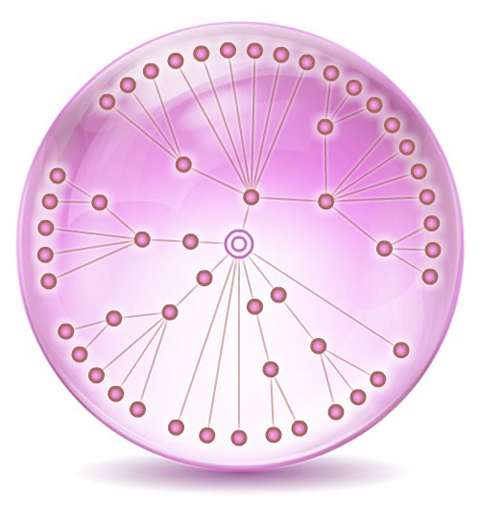
Digging a little deeper, the research team dove into scientific papers looking for places where researchers quoted the incubation period of different viruses, from influenza to measles. Every time a claim was made, they traced the network of citations back to the original data source (and provided a cool visualization of the path, to boot). For example, many studies will set the stage for their own research by saying that it’s commonly known that the incubation period for influenza is 1-4 days, and next to that statement, they’ll put a small reference in parenthesis, which signals where they obtained that information.
The problem is, many articles cited another study, that cited another study, which in turn cited yet another – you get the picture. It’s like a really bad version of the “telephone game" played by kids. And 50% of the time, the researchers found no original source of incubation period data when they started backtracking. Scary stuff.
By factoring in review articles, which are supposed to be a comprehensive analysis of a field of research, the team found that 65% of viral incubation data never gets cited again after its first publication. 65%! Granted, review articles have to factor in the quality of the research done in individual experiments. So is that much crappy research being done, or is the majority of science in this particular arena simply falling into the growing chasm of “dark data”?
I’ve been chewing on this article for a while, waiting for the right time to write something about it. Today, a tweet by Nieman Lab caught my attention, and spurred me into action.
The tweet pointed to a post on Doc Searls’ blog asking media outlets to do a better job linking to original sources (I, like Searls, get super-frustrated with the NYT, when they either don’t link to a source, or you click on the underlined blue text thinking you’ll be enlightened by profound insight, only to find you’ve been swept away to some vaguely-related post authored by another NYT staffer).
Time to add scientists to your list of offenders, Doc.
Photo via Flickr / Dan Zen
Citation: Reich NG, Perl TM, Cummings DAT, Lessler J, 2011 Visualizing Clinical Evidence: Citation Networks for the Incubation Periods of Respiratory Viral Infections. PLoS ONE 6(4): e19496. doi:10.1371/journal.pone.0019496
** Update, 18 May 2011: The statistics cited in this post (50% of original data not traced back to source, 65% of studies never cited again) apply, in this case, to viral incubation data only. The authors didn't extrapolate these findings to other medical claims. I updated the statements above to make this explicitly clear. -bjm
Brian Mossop is currently the Community Editor at Wired, where he works across the brand, both magazine and website, to build and maintain strong social communities. Brian received a BS in Electrical Engineering from Lafayette College, and a PhD in Biomedical Engineering from Duke University in 2006. His postdoctoral work was in neuroscience at UCSF and Genentech.
Brian has written about science for Wired, Scientific American, Slate, Scientific American MIND, and elsewhere. He primarily cover topics on neuroscience, development, behavior change, and health.
Contact Brian at brian.mossop@gmail.com, on Twitter (@bmossop), or visit his personal website.
Genomic research center brings industry and academia together
In 2004, a group of researchers – some from academia, others from industry – took stock of the future of genetic research. The Human Genome Project had been completed the year prior, and at the time they communicated their thoughts to the journal Genome Research, roughly 200 species already had their complete genomes sequenced, with another chiliad still under investigation in laboratories across the country.

In 2004, a group of researchers – some from academia, others from industry – took stock of the future of genetic research. The Human Genome Project had been completed the year prior, and at the time they communicated their thoughts to the journal Genome Research, roughly 200 species already had their complete genomes sequenced, with another chiliad still under investigation in laboratories across the country.
The group knew that mapping out the chemical alphabet of life was only the first step. The implications of the genetic code, like its role in disease, would only be resolved by opening up the scientific process – sharing datasets and encouraging multidisciplinary research teams. And success, they argued, would inevitably require a close collaboration between the industrial and academic powers.
Today, news broke that Eric Shadt, Chief Scientist at Pacific Biosciences – a corporate leader in next-generation genetic sequencing – will direct a new genomics research center at Mt. Sinai School of Medicine. In doing so, Shadt will help bridge the divide that researchers at both institutions often face. The medical school will gain premier access to Pacific Biosciences’ state-of-the-art technology, while the company will get hold of an abundance of genetic samples from patients in the clinic, streamlined by Mt. Sinai’s electronic medical record system.
While drug development companies have successfully partnered with academic labs in the past (most often to license intellectual property like new potential drugs), the partnerships have historically been fraught with legal parley and institutional red-tape. But since Shadt will directly broker the alliance by also retaining a part-time role at Pacific Bioscience (25% of his time), the two organization may be able to bypass some of the usual reluctance.
Photo via Flickr
Brian Mossop is currently the Community Editor at Wired, where he works across the brand, both magazine and website, to build and maintain strong social communities. Brian received a BS in Electrical Engineering from Lafayette College, and a PhD in Biomedical Engineering from Duke University in 2006. His postdoctoral work was in neuroscience at UCSF and Genentech.
Brian has written about science for Wired, Scientific American, Slate, Scientific American MIND, and elsewhere. He primarily cover topics on neuroscience, development, behavior change, and health.
Contact Brian at brian.mossop@gmail.com, on Twitter (@bmossop), or visit his personal website.
Winds of change in biotech R&D
There is a cool article in the June issue of The Atlantic by Quinn Norton about the rise of niche biotech/drug development outfits. And while I think the title (“The Rise of Backyard Biotech”) is misleading, especially because it features Hugh Rienhoff, who is a trained physician and clinical geneticist – by all means a wee bit more advanced than a garage biohacker who’s trying to make genetic medicines – there is a well-articulated message within the story: it’s time for BigPharma R&D to step out of the limelight. The future of biotech discovery and development will be crafted in these specialized, small, startup companies. I couldn’t agree more*. But I’d take the argument one step further: This isn’t something that may happen in the future, but rather, I think that time may already be upon us.
There is a cool article in the June issue of The Atlantic by Quinn Norton about the rise of niche biotech/drug development outfits. And while I think the title (“The Rise of Backyard Biotech”) is misleading, especially because it features Hugh Rienhoff, who is a trained physician and clinical geneticist – by all means a wee bit more advanced than a garage biohacker who’s trying to make genetic medicines – there is a well-articulated message within the story: it’s time for BigPharma R&D to step out of the limelight. The future of biotech discovery and development will be crafted in these specialized, small, startup companies. I couldn’t agree more*. But I’d take the argument one step further: This isn’t something that may happen in the future, but rather, I think that time may already be upon us.

A quick look into Genentech’s website reveals that of the 20 drugs in their pipeline with information available to a site visitor, 9 of them (45%) have been either developed in conjunction with, or licensed from, another (more than likely smaller) biotech company.
Clearly this is only a glimpse at the future products that may stem from Genentech’s efforts, and certainly doesn’t take into account the potential therapeutic still sitting in petri dishes on lab benches that haven’t yet worked their way through the system. And by all means, I don't think this paradigm is unique to Genentech -- I suspect other companies have adapted similar strategies.
But it’s difficult to ignore the idea that the winds of innovation in biotech R&D have already shifted.
*Disclaimer: I was previously employed by Genentech. But all of the information used to write this post was gleaned from the company’s pipeline website.
Brian Mossop is currently the Community Editor at Wired, where he works across the brand, both magazine and website, to build and maintain strong social communities. Brian received a BS in Electrical Engineering from Lafayette College, and a PhD in Biomedical Engineering from Duke University in 2006. His postdoctoral work was in neuroscience at UCSF and Genentech.
Brian has written about science for Wired, Scientific American, Slate, Scientific American MIND, and elsewhere. He primarily cover topics on neuroscience, development, behavior change, and health.
Contact Brian at brian.mossop@gmail.com, on Twitter (@bmossop), or visit his personal website.
Hepatitis C, drug resistance, and personalized medicine
A huge boost to treatment for the Hepatitis C virus (HCV) is on the horizon, as two pharmaceutical companies are set to release new drugs to market. And with development complete, the marketing war begins. Forbes reports that Merck has won FDA approval for Victrelis, and the drug, which costs $35,000 for the course of treatment, will hit pharmacies' shelves by next week, along with the company's targeted marketing campaign.
A huge boost to treatment for the Hepatitis C virus (HCV) is on the horizon, as two pharmaceutical companies are set to release new drugs to market. And with development complete, the marketing war begins. Forbes reports that Merck has won FDA approval for Victrelis, and the drug, which costs $35,000 for the course of treatment, will hit pharmacies' shelves by next week, along with the company's targeted marketing campaign.
But Merck is on the clock, since a favorable approval from the FDA expected on rival drug, Incivek, manufactured by Vertex Pharmaceuticals by the end of the month.
A quick look into the Phase III studies conducted by Merck and Vertex reveals that both HCV drugs are protease inhibitors intended to be given in combination with other currently available treatments. And a paper published this past February in Science Translational Medicine provides a plausible explanation why, going forward, choosing the proper drug cocktail for each patient will be crucial.
It seems that HCV can rapidly mutate, perhaps even faster than HIV or Hepatitis B, and successfully combating this disease will require substantial efforts in personalized medicine:
Overall, this study predicts that rapid emergence of HCV protease inhibitor resistance in patients, particularly those with genotype 1a infection and with high viral loads, is expected. Combination therapies of direct antivirals with/without IFN+/-RBV would be promising to combat drug resistance. However, as with HIV, they need to be chosen carefully and with regard to both preexisting and on-treatment generated drug-resistant variants.
Brian Mossop is currently the Community Editor at Wired, where he works across the brand, both magazine and website, to build and maintain strong social communities. Brian received a BS in Electrical Engineering from Lafayette College, and a PhD in Biomedical Engineering from Duke University in 2006. His postdoctoral work was in neuroscience at UCSF and Genentech.
Brian has written about science for Wired, Scientific American, Slate, Scientific American MIND, and elsewhere. He primarily cover topics on neuroscience, development, behavior change, and health.
Contact Brian at brian.mossop@gmail.com, on Twitter (@bmossop), or visit his personal website.
Innovation, a story told by patent applications
Malcolm Gladwell has a homerun piece in this week's New Yorker, looking into the lesser-known facts of the Silicon Valley tall-tale of how Steve Jobs "stole" the idea for the computer mouse from PARC Xerox. Painting the Apple exec as a thief is a misnomer, and unfair in many ways, Gladwell attests. Jobs was merely doing what Jobs does best: identifying a great concept and making it even better. The article explains how in the days following his meeting at Xerox PARC, Jobs enlisted Dean Hovey, one of the founders of a design firm that would become IDEO to draft concepts for the first personal computer and mouse, while the engineers at Xerox PARC, some years later, went on to make their own revolutionary product, the laser printer.
Malcolm Gladwell has a homerun piece in this week's New Yorker, looking into the lesser-known facts of the Silicon Valley tall-tale of how Steve Jobs "stole" the idea for the computer mouse from PARC Xerox. Painting the Apple exec as a thief is a misnomer, and unfair in many ways, Gladwell attests. Jobs was merely doing what Jobs does best: identifying a great concept and making it even better. The article explains how in the days following his meeting at Xerox PARC, Jobs enlisted Dean Hovey, one of the founders of a design firm that would become IDEO to draft concepts for the first personal computer and mouse, while the engineers at Xerox PARC, some years later, went on to make their own revolutionary product, the laser printer.
After reading Gladwell's story, I started digging into the intellectual property history of Apple and Xerox PARC , specifically looking into the patent landscape around the time the companies were hashing out the personal computer and the first mouse in the early 80s. And in a strange way, the chronology of patent filings in the years following the now-historic meeting compliments the personality difference Gladwell paints between first movers and fast followers.

Behind closed-door meeting in the early 80s, Jobs' savvy insight into what customers wanted combined Hovey's ingenuity, allowing them to quickly scrape ideas together. In November 1980, the two (along with Jerrold Manock, of Apple, and David Kelley, another IDEO founder) sketched out their chic design for a personal computing system (well, at least compared to Xerox PARC's model), and just a few years later, in 1982, reserved the intellectual rights to their version of the mouse.
Apple, of course, went on to market the successful Macintosh computer. But what happened to the other characters involved, Hovey and Xerox PARC, in the immediate aftermath?
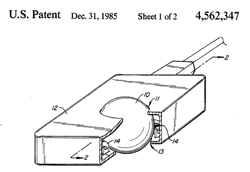
Well, we know that the mouse had captured Hovey's attention, and he went about making slight improvements to the device he and Jobs had registered with the US Patent Office. In 1983, after he founded his own company called Trace Systems, Inc., Hovey filed a patent for a device which, when held one way would function as a mouse, but when flipped around, its housing would provide enough support so that it could be used as a standard trackball.
At Xerox PARC, business also continued as usual. But true to form, the new effort of one of their engineers was once again marked by before-its-time innovation. Around the same time Hovey was filing intellectual property for modest improvements on an old design, an engineer at the research center named Richard Lyon filed a patent application, by himself, detailing a new kind of computer mouse, one that no longer needed that pesky trackball to move the cursor around. This new version would instead rely on optical sensors to keep tabs on the peripheral device's movement.
Wikipedia says the first "commercially successful" optical mouse debuted in 1999. But once again Xerox PARC was well ahead of the curve, 16 years to be precise.
As Gladwell says in his story, it's difficult for a company to be both a true innovator and one that can readily bring consumer products to market. And as the patents show, Xerox PARC and Apple weren't adversaries, because it seems they were never competing for the same prize.
Brian Mossop is currently the Community Editor at Wired, where he works across the brand, both magazine and website, to build and maintain strong social communities. Brian received a BS in Electrical Engineering from Lafayette College, and a PhD in Biomedical Engineering from Duke University in 2006. His postdoctoral work was in neuroscience at UCSF and Genentech.
Brian has written about science for Wired, Scientific American, Slate, Scientific American MIND, and elsewhere. He primarily cover topics on neuroscience, development, behavior change, and health.
Contact Brian at brian.mossop@gmail.com, on Twitter (@bmossop), or visit his personal website.
Long Live Lego
The Economist has a good story on the continued popularity of Lego, the children's toy with the now iconic interlocking plastic bricks first introduced in 1949.
While many of its competitors struggle to compete or are stymied by tainted supply chains from toxic scares in manufacturing centers in China, Lego is catapulting forward, capturing 5.9% of the global toy market and surpassing $1B in sales for the first time.

The Economist has a good story on the continued popularity of Lego, the children's toy with the now iconic interlocking plastic bricks first introduced in 1949.
While many of its competitors struggle to compete or are stymied by tainted supply chains from toxic scares in manufacturing centers in China, Lego is catapulting forward, capturing 5.9% of the global toy market and surpassing $1B in sales for the first time.
It's quite an inspiring story considering the company almost went belly-up 4 years ago.
How did they do it? With constant innovation (something every company should keep in mind):
It helps that parents like Lego’s toys (except when they tread on stray bricks with bare feet). Playing with bricks is said to enhance motor skills, creativity and other things that grown-ups fuss about. Last year in America Lego launched family board games with boards that need to be built and even a buildable dice. They instantly captured 12.6% of the market. A Lego website, Design byME, offers free software that allows brats to design their own Lego castle, spaceship or ginormous monster with huge fangs. They can send off their design, receive the bricks in the post and start building it.
** Photo credit: Flickr / Flying Cloud
Brian Mossop is currently the Community Editor at Wired, where he works across the brand, both magazine and website, to build and maintain strong social communities. Brian received a BS in Electrical Engineering from Lafayette College, and a PhD in Biomedical Engineering from Duke University in 2006. His postdoctoral work was in neuroscience at UCSF and Genentech.
Brian has written about science for Wired, Scientific American, Slate, Scientific American MIND, and elsewhere. He primarily cover topics on neuroscience, development, behavior change, and health.
Contact Brian at brian.mossop@gmail.com, on Twitter (@bmossop), or visit his personal website.
It's Not The Coach's Fault
My latest story for Wired Playbook discusses recent research from a group that analyzed 46 seasons of professional German soccer league data to determine that firing a coach mid-season -- a tactic clubhouses use to jump-start a fledgling team -- has absolutely no effect on the squad's performance.
My latest story for Wired Playbook discusses recent research from a group that analyzed 46 seasons of professional German soccer league data to determine that firing a coach mid-season -- a tactic clubhouses use to jump-start a fledgling team -- has absolutely no effect on the squad's performance.
So, to really compare apples to apples and provide a clearer picture of what effect a new coach has on a losing team, Heuer thought it better to identify suitable control groups — teams that had bad luck, but stuck it out with their current coach for the rest of the season — and compare them to teams that handed their coach a pink slip when times got tough.
As they suspected, there was absolutely no difference between the teams that fired or retained their coach, as all teams that experienced an early period of bad luck showed improvement later in the season. But pride is a formidable enemy, and the data consistently showed that in many cases, a team decided to prematurely give their coach the boot after they took a beating on two consecutive games.
Read the full story here.
Photo via Flickr / BrokenRhino

Heuer, A., Müller, C., Rubner, O., Hagemann, N., & Strauss, B. (2011). Usefulness of Dismissing and Changing the Coach in Professional Soccer PLoS ONE, 6 (3) DOI: 10.1371/journal.pone.0017664
Brian Mossop is currently the Community Editor at Wired, where he works across the brand, both magazine and website, to build and maintain strong social communities. Brian received a BS in Electrical Engineering from Lafayette College, and a PhD in Biomedical Engineering from Duke University in 2006. His postdoctoral work was in neuroscience at UCSF and Genentech.
Brian has written about science for Wired, Scientific American, Slate, Scientific American MIND, and elsewhere. He primarily cover topics on neuroscience, development, behavior change, and health.
Contact Brian at brian.mossop@gmail.com, on Twitter (@bmossop), or visit his personal website.