Using Twitter to track flu outbreaks
When public health officials track the outbreak of a virus, like H1N1, it takes time to get the story right. They have to collect and assemble data from institutions scattered across the country, a process that can be, well, slow.
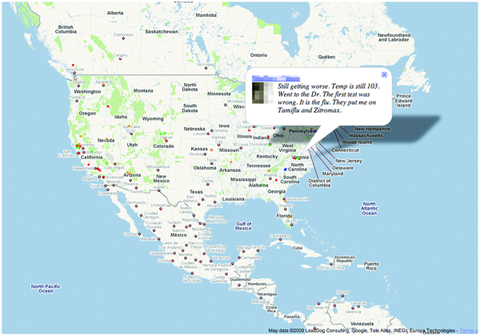
When public health officials track the outbreak of a virus, like H1N1, it takes time to get the story right. They have to collect and assemble data from institutions scattered across the country, a process that can be, well, slow.
For instance, at the CDC’s FluView website, you can see statistics for influenza trends across the country. But today’s “weekly influenza report” was assembled with data from the week ending 7 May 2011. Or put another way, the latest information is already 11 days old.
It seems crazy that sometimes the information we desperately need is the most difficult to get, but it’s all too often true. You can up-to-the-minute details on the location of your neighborhood’s taco truck, but if you want flu data, you’ll have to wait about 2 weeks.
The difference, of course, is that the food trucks have wholeheartedly embraced social media, which has quickened the pace of information flow. And as more and more people are using services like Twitter – which in 2010 was growing at a rate of 300,000 users each day – a savvy group of researchers from the University of Iowa wondered: if people are using Twitter to catalogue the minutia of their lives, could the tweets be analyzed to better track outbreaks of the flu?
Starting in April 2009, the research team led by Philip Polgreen, an assistant professor in the Department of Internal Medicine, starting logging tweets from users living in the US, and combed thru the data, filtering for certain keywords, like flu, swine, influenza, vaccine, H1N1, Tamiflu, etc.
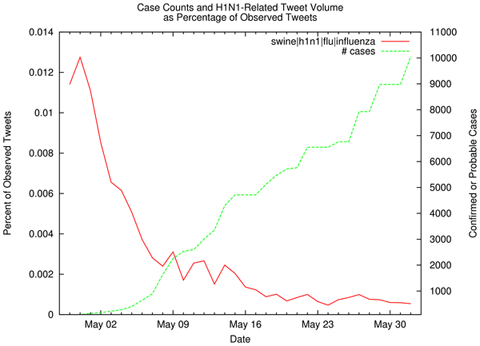
The first thing they noticed was that the general Twitter chatter about H1N1 peaked before the outbreak surfaced (check out the figure above). The red line represents the percentage of tweets talking about the flu or flu-like illness, while the green line shows the number of confirmed or probable cases. Whether this reflects an ability of social media to "predict" an outbreak remains unclear. But one thing's certain: people were aware of the storm that was brewing.
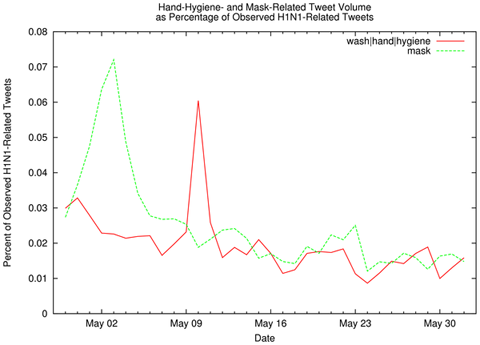
According to the study, in early May 2009, the CDC released targeted messaging to consumers about the importance of flu prevention. So when the team searched through the Twitter data for specific phrases like "mask" or "hand hygiene" they were able to gauge how prevention strategies were rippling through the virtual community. [Notice the two distinct peaks in Twitter traffic for "mask" (green line) and "hand hygiene" (red line) in the figure above.]
Seeing how Twitter chatter of certain keywords, however interesting it may be, doesn't do anything to address the larger problem, which is: How many people are infected with the flu at this very point in time? So the team devised a complicated statistical model to estimate the number of people infected with the flu based on their Twitter status. And surprisingly, when they compared their numbers (red line in figure below) to the count generated by the CDC (green line), they discovered the data were indistinguishable. However, they would have had the current estimates in hand a lot sooner than the CDC.
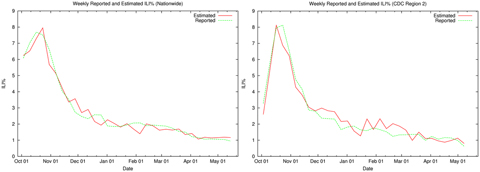
The authors acknowledge that their model needs to be validated by others. So consider this finding exactly what it is, a solid first step in a lengthy journey.
Citation: Signorini A, Segre AM, Polgreen PM, 2011 The Use of Twitter to Track Levels of Disease Activity and Public Concern in the U.S. during the Influenza A H1N1 Pandemic. PLoS ONE 6(5): e19467. doi:10.1371/journal.pone.0019467
Brian Mossop is currently the Community Editor at Wired, where he works across the brand, both magazine and website, to build and maintain strong social communities. Brian received a BS in Electrical Engineering from Lafayette College, and a PhD in Biomedical Engineering from Duke University in 2006. His postdoctoral work was in neuroscience at UCSF and Genentech.
Brian has written about science for Wired, Scientific American, Slate, Scientific American MIND, and elsewhere. He primarily cover topics on neuroscience, development, behavior change, and health.
Contact Brian at brian.mossop@gmail.com, on Twitter (@bmossop), or visit his personal website.
Life, Liberty, and the Pursuit of Affordable Health Care
In my opinion, our inalienable rights should be restated as the title of this post suggests. But despite my wishful thinking, health care costs continue to rise. By 2030, the boomer generation will place 57.8 million people in the 66-84 age group, further burdening current government funding for Medicare. The outlook is bleak, and the system needs fixing. One idea for lowering health care costs is to move health services out of the clinic, and into the home. New web-based services and personal diagnostic equipment now enable patients to receive medical care from the comfort of their living room. Is it realistic this model will reduce costs and stick? I'll cover the web-based services in this post, and follow up with another post on home diagnostic equipment. Web-based doctor's appointments are now available in several states. For example, at $10 per month, and $50 per consultation, SwiftMD offers an online health care plan in New York and New Jersey. Within 30 minutes of scheduling an appointment, subscribers have either a phone conversation or an online video chat with an available physician. If prescriptions are required, the physician sends the request electronically to the pharmacy of the subscriber's choice. A step further in service, Hello Health adds conveniences such as the ability to text, instant message, or tweet your doctor, and also offers clinic appointments or house calls for more serious conditions. Both SwiftMD and Hello Health do not cover major medical expenses, so if the subscriber has to go to the emergency room or be admitted to the hospital, the cost is theirs. Also, neither accepts insurance, but compared to ever increasing health insurance premiums and the number of uninsured patients, an affordable "pay for what you need" model may just work.
In my opinion, our inalienable rights should be restated as the title of this post suggests. But despite my wishful thinking, health care costs continue to rise. By 2030, the boomer generation will place 57.8 million people in the 66-84 age group, further burdening current government funding for Medicare. The outlook is bleak, and the system needs fixing. One idea for lowering health care costs is to move health services out of the clinic, and into the home. New web-based services and personal diagnostic equipment now enable patients to receive medical care from the comfort of their living room. Is it realistic this model will reduce costs and stick? I'll cover the web-based services in this post, and follow up with another post on home diagnostic equipment. Web-based doctor's appointments are now available in several states. For example, at $10 per month, and $50 per consultation, SwiftMD offers an online health care plan in New York and New Jersey. Within 30 minutes of scheduling an appointment, subscribers have either a phone conversation or an online video chat with an available physician. If prescriptions are required, the physician sends the request electronically to the pharmacy of the subscriber's choice. A step further in service, Hello Health adds conveniences such as the ability to text, instant message, or tweet your doctor, and also offers clinic appointments or house calls for more serious conditions. Both SwiftMD and Hello Health do not cover major medical expenses, so if the subscriber has to go to the emergency room or be admitted to the hospital, the cost is theirs. Also, neither accepts insurance, but compared to ever increasing health insurance premiums and the number of uninsured patients, an affordable "pay for what you need" model may just work.
A recent article highlighted the services of Hello Health, and discussed the ways electronic media is reshaping health care. More important than describing cool, new ways to communicate with your doctor, and boutique concierge services offered by modern clinics, the article does a fine job pointing out the importance of social networking in the future of health care. Physicians use websites such as Sermo and UpToDate to stay abreast of advances in health care and treatment, as well as to network with other doctors in the field. Patients, on the other hand, have traditionally been stuck with tools such as WebMD, NIH's MedlinePlus, and the Mayo Clinic site, all of which just give background information on diseases, and pave the way for dangerous self-diagnosis.
Such patient websites provide little help to the proactive patient who is curious if others with a certain condition are experiencing similar symptoms or medication side effects. Enter PatientsLikeMe, a website that focuses on user-generated data (via self monitoring and reporting) and lets others know what to expect on the road ahead. PatientsLikeMe provides a useful social networking community if you are already diagnosed with a condition, but what if you are a 40-something male with a BMI of 28, blood pressure at 135/85, and recently diagnosed with metabolic syndrome? Is there anyone out there with similar stats that can offer information about what regiments have kept them healthy? In other words, let's not wait until we are diagnosed with heart failure to seek out advice from our peers -- we need social networking tools when we are still just "at-risk" for the disease.
While electronic access to your physician is much cheaper than going to an office visit, to truly drive health care costs down, we need to increase the personal responsibility of the public -- we need to heighten our medical knowledge, track our own body metrics, and pool our data. Social networking sites provide the necessary framework to disseminate such information and personal experiences across large populations. Armed with the proper information, patients will be able to make their own decisions about their health. Now that's a true health care revolution -- so go tweet your way to better health. I'll discuss home diagnostic testing soon...